








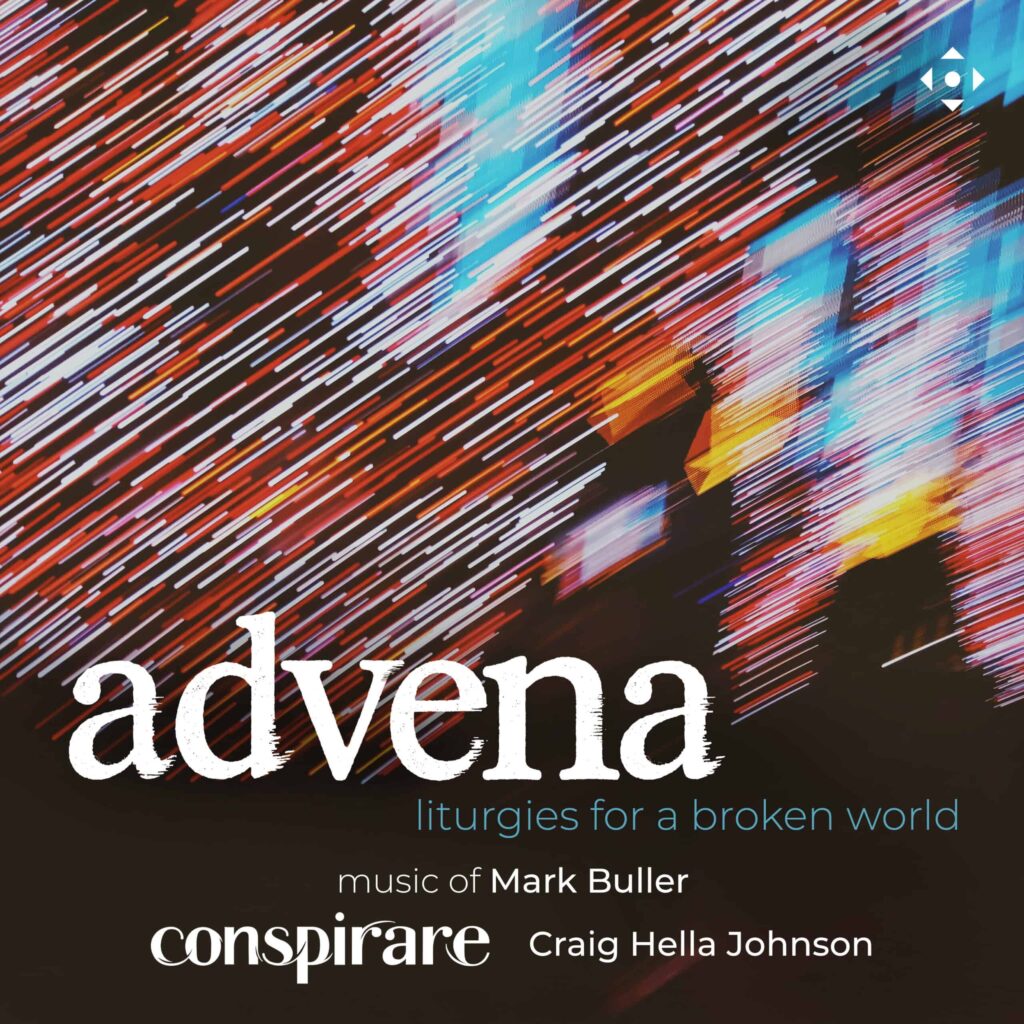
Issued in the late summer of 2025, Conspirare’s advena: liturgies for a broken world has never felt more relevant than right now. While the word advena (Latin for “stranger” or “foreigner”) resonates for its associations with migration, displacement, and exile, the other part of the title references the fracturing of justice and collapsing of partnerships occurring throughout the world. Set to texts by librettists Leah Lax and Euan Tait, four works by Houston-based composer Mark Buller are presented by the GRAMMY®-winning choral ensemble Conspirare and its Artistic Director and conductor Craig Hella Johnson on an album that addresses the strife of contemporary living whilst also holding onto the possibility of hope, recovery, and transformation. Words by Johnson included with the project have proven to be particularly prescient: “We find ourselves in a pivotal cultural moment—one that calls for expressions of beauty and truth, offered both for inspiration but also as acts of resistance.”
On the sixty-six-minute release, two short settings, Introit: Fruit of Your Heart and Communion: A Questioning (Tait), frame the multi-movement liturgies Mass in Exile and Requiem in the Light (Lax). The contemplative, chant-like bookends ease the listener into and out of the release and enhance its thematic design and structural arc whilst also helping induce states of calm and reflection. The core liturgies reconfigure ancient forms through contemporary prisms in expressions that are emotionally intense, thought-provoking, and permeated by urgency. Bringing the works into being are the choir ensemble—on this recording, six sopranos, five altos, four tenors, and five basses—and instrumentalists Patrice Calixte and Mariama Alcântara (violins), Bruce Williams (viola ), Douglas Harvey (cello), Marc Garvin (guitar), Jessica Valls (bass), and Thomas Burritt (percussion). Solo turns are taken by vocalists Simon Barrad (bass), Emily Yocum Black (soprano), and Michael Hawes (bass). Whereas some choral ensemble recordings understandably use the non-vocal contributors as a backdrop, here their contributions are pivotal to the compositions and the music’s impact.
That’s immediately apparent when Introit: Fruit of Your Heart opens with the lilt of unaccompanied acoustic guitar, which establishes a gentle portal for the singers’ becalmed utterances and unison harmonies. In rapid succession comes Mass in Exile, which similarly begins with non-vocal elements, in this case string remonstrations that start broodingly before swelling ferociously. Political developments provided a strong impetus for Buller’s seven-part mass, with, in his words, its creation “born out of years of frustration and disillusionment coming to a head in 2016, when the people from my fundamentalist background made a choice a full 180 degrees from what they’d taught me as a child—that morality matters in political leadership.” The exiled alluded to in the opening “For Want of Refuge (Miserere)” are the children separated from their parents at the Texas border, a detail that instantly grounds the mass in our traumatizing real-world context. Desperation, longing, and anguish pervade the choir’s declamations, after which “Credo in Exile” returns the work to a peaceful state with the choir softly intoning a guitar-accompanied chorale on the words “Pray child, pray.” Barrad steps forth with spiritual self-questioning, his spotlight affecting in its sincerity and confessional character. Again we’re reminded of the important role the instrumentalists play when the strings re-enter alone until they’re replaced by the choir’s earnest supplications and a moving second turn by the vocal soloist.
After “Peaceable Kingdom Gloria,” a tender paean to human love, brings an episode of heavenly luminosity to the work (“Don’t fade, my love – I hear your song”), reality raises its harsh head once more via the vituperative “As Water Flows Away (Prayer for the Government)” and its scathing accusations (“Do you think you speak justice?”). A second, inward-probing “Mercy (Kyrie)” and prayerful “Earth Sanctus: Body and Blood” follow, the latter marked by choral repetitions of the Hebrew word kadosh (“holy”) and then with Barrad “Holy Holy Holy,” before the mass concludes with “When All Else Falls Away (Benedictus)” and an entrancing reflection delivered by Hawes, the choir, and a soprano duo.
Presented in five parts, Requiem in the Light forms a seamless companion to Mass in Exile. The seriousness of its subject matter is announced by the haunting “Lacrimosa for the Murdered” with its expression of longing and angst-ridden vocal tapestry. Buller again bolsters the material’s impact using instrumental elements, strings central to the opening movements. “Confutatis: Morning Light” sustains the music’s haunting tone with musings on the hope a new day engenders. Quick to blossom is the gently rhapsodic “Prayer to the Body (Domine Jesu),” while the penultimate “No Trumpets: Prayer to the Earth (Dies Irae)” offers an elegiac, multi-lingual plea to undo the damage we’ve done. After a glorious major chord ushers the “Requiem (Agnus Dei)” and the work proper to a close, advena ends with Communion: A Questioning, where Black, a section of singers, and strings gather for one final luminous meditation.
In concert with his librettists Lax and Tait, Buller has crafted powerful and enriching choral material for Conspirare and Johnson to perform, such works important for their probing spiritual dimensions but also their real-world applications. While they acknowledge directly the darkness of our times and this so-called broken world, they don’t rule out the possibility of recovery, no matter how remote it might currently seem. To despair over the way things are is understandable, but it’s hardly the only course of action available.