








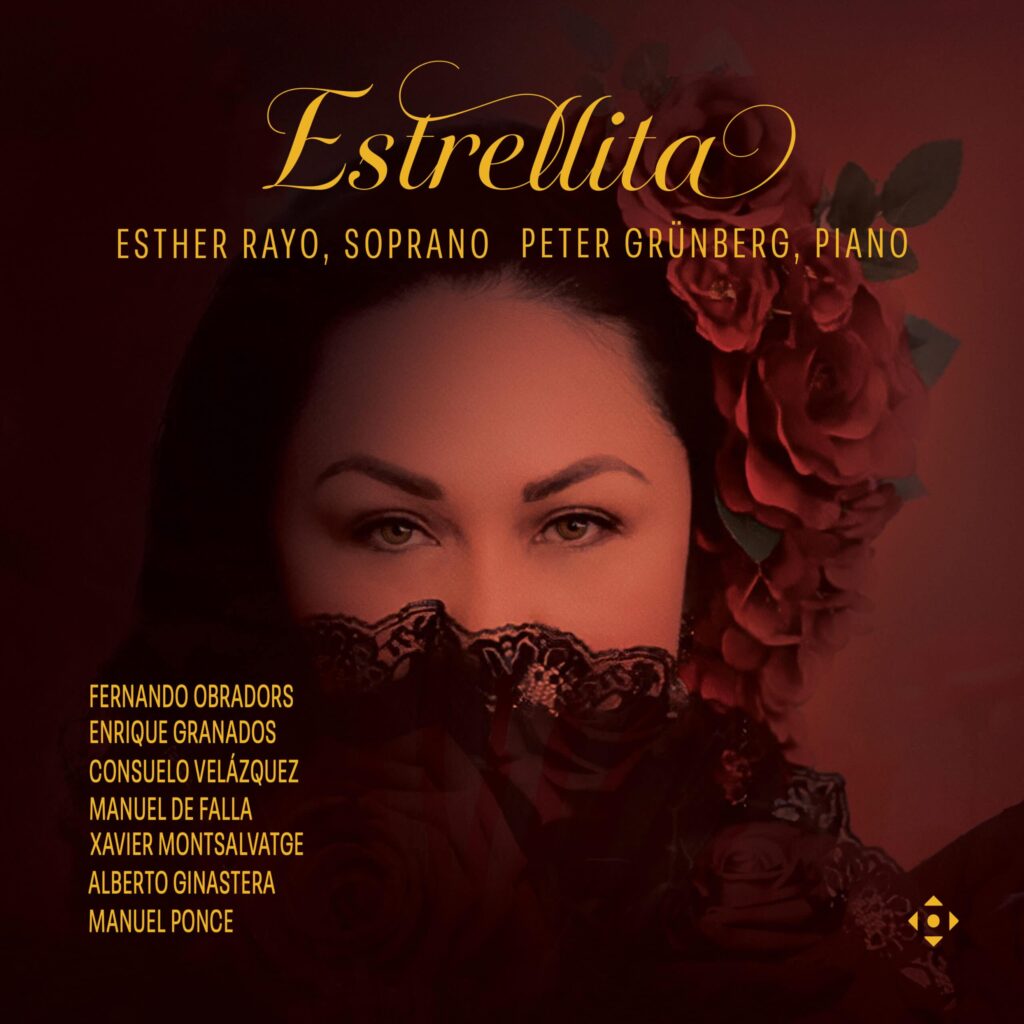
This recital of Spanish songs derives from a series of concerts given by an organisation from San Francisco called LIEDER ALIVE! The songs are by early-20th-century composers Fernando Obradors, Manuel de Falla, Enrique Granados, Alberto Ginastera, Xavier Montsalvatge, Consuelo Velázquez and Manuel Ponce. Even lieder aficionados may not encounter all these songs often. There is plenty of enjoyment on offer, even if much here would be new to many, beyond the familiar Falla set. All songs draw from Spanish classical poetry. While some have newly composed tunes, others use regional folk melodies, widely remembered if not always written down before. So they act as a way of preserving heritage, and will appeal to art song lovers, folksong admirers and perhaps most first-time listeners.
The songs are not so Spanish as to have guitar accompaniment, but occasionally they deploy the piano in a guitar-like way. In a number of songs, the piano also exploits its own characteristic complexity. Thus in the opening Obradors selection, the fugal accompaniment of the song La mi sola, Laureola belies the simple lyrics of the text. In the cradle song from the same set, Con amores, the poem recalls the singer’s infancy. The piano suggests a lullaby, but fear not – it is too hypnotically entrancing to lull you to sleep.
Three of Granados’s twelve Tonadillas en estilo antigo (tunes in the old style) have been chosen. Each is entitled La maja dolorosa (the sorrowful woman), but with different texts. They portray the Woman’s response to the death of her beloved, and show that variety can be achieved even with the universal emotion of keening upon bereavement. This delightful triptych is succeeded by the one piano solo on the disc, from Granados’s piano suite Goyescas.
The next song is the most familiar by far: Besame mucho (give me many kisses) is a standard heard in many idioms and arrangements. The sixteen-year old Consuelo Velázquez wrote the original heard here in response to that Granados piano solo. Pianist Peter Grünberg arranged it for soprano Esther Rayo.
Falla’s Siete Canciones populares españolas (seven popular Spanish songs) was one of the composer’s calling cards, the first work to announce his importance to the world. It is also unusual in that he imports unchanged folk and popular material, just adding his own harmonic spice in the piano part. This rightly forms the centrepiece of the recital. Esther Rayo does these charming songs full justice. She catches the idiom, and finds the flavour of each of the chosen items. (Why not do all seven?)
But then Rayo is vocally persuasive throughout the recital, and the pianist gives her excellent support; sample his introduction and accompaniment in Falla’s irresistible Jota, and the final Polo. The Montsalvatge and Ginastera selections are just as agreeable, as is the title song of the disc, the Mexican Manuel Ponce’s Estrellita, placed last. This “little star” is another familiar favourite, and a suitably sensuous close to a highly attractive recital.
There is a suitable acoustic for this intimate genre, which the recording has caught well. The booklet has good notes in English, and full song texts in Spanish with English translations.