






Ever since Chopin wrote his 24 Preludes, Op. 28, in the 1830s (a work doubtless inspired by the two sets of preludes Bach composed to introduce the fugues of The Well-Tempered Clavier), composers have been intrigued by this musical form. Chopin’s preludes were, of course, not followed by fugues, but functioned perfectly as stand-alone pieces, although he himself never performed more than four of them in a single recital. As far as sets of preludes go, it seems likely that more collections contain 24 pieces than any other number, reflecting the 24 major and minor keys of Western music.
In my own recording library, I have 23 such sets by composers after Chopin, specifically Felix Blumenfeld, York Bowen, Alan Bush, César Cui, Hans Gál, Dmitri Kabalevsky, Alexander Kasyanov, Michel Merlet, Krzysztof Meyer, Maurice Ohana, Selim Palmgren, Manuel Ponce, Sergei Rachmaninoff, Nikolai Roslavets, Guy Sacre, Robert Schollum, Alexander Scriabin, Adrian Self, Dmitri Shostakovich (who wrote two additional sets of 24 Preludes beyond those attached to his Preludes and Fugues), Charles Villiers Stanford, Sulkhan Tsintsadze, and Andrew Zatman. Some complete sets, including those of Shostakovich and Zatman, follow Chopin’s key sequence through the circle of fifths, in which each major key is immediately followed by its relative minor (C major, A minor, G major, E minor, and so on). Others dispense with such a scheme altogether. Indeed, Polish modernist Krzysztof Meyer, not surprisingly, abandons key designations entirely in his 24 Preludes.
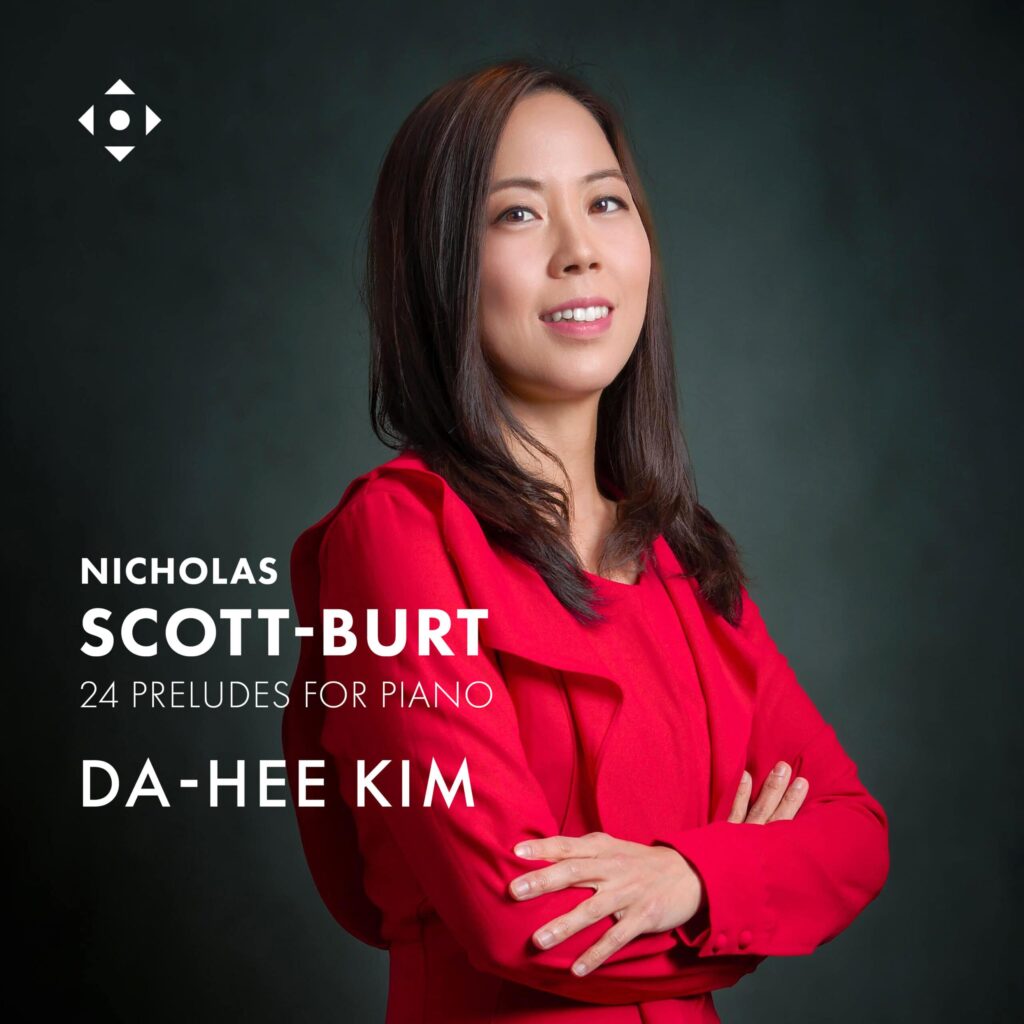
Nicholas Scott-Burt, new to these pages, has devised his own approach. Each prelude has its own key, but he has arranged the pieces so they flow seamlessly into one another, forming a great piano “symphony” consisting of four “suites,” each containing six preludes rather than traditional movements. Thus, for example, the keys of the first suite are C major, D minor, D-flat major, E-flat minor, D major, and E minor, with the tonic pitches following the intervallic sequence of “up a whole step, then down a half step.” This pattern is repeated throughout the entire cycle. To my mind, this structure—especially given the consistent alternation between major and minor keys—is both musically and intellectually satisfying. I confess that music theory was one of my graduate-school minors, so I find such structural ingenuity particularly rewarding.
I wrote all of the above before actually listening to the work, as I wanted to understand Scott-Burt’s architecture in advance. The opening Prelude in C major bears some kinship to the first Prelude of Bach’s Well-Tempered Clavier, both in its simplicity and in the gradually evolving, mesmerizing figures derived from broken chords. An idyllic Prelude in D minor follows, its gentle spirit continuing into the D-flat major Prelude, which features a recurring Scotch snap (short-long rhythm) before closing with a few non-diatonic harmonies. The first fast-paced prelude arrives with No. 4 in E-flat minor, a minute-long whirlwind featuring rapidly alternating chords between the pianist’s hands. Prelude No. 5 in D major is one of the more pointillistic tonal works I have encountered, while the closing Prelude of the first suite, in E minor, is another gentle piece whose melodic shaping and contrapuntal dexterity reveal a pronounced Bachian influence. It also briefly reaches the loudest dynamic heard so far.
The second suite is somewhat more extroverted than the first, and Scott-Burt continues to broaden his harmonic palette in productive and appealing ways. Notable examples include the densely textured chords of Prelude No. 9 and the restless energy of Prelude No. 10, a true moto perpetuo. Interestingly, Prelude No. 11 returns to the thick chordal writing of No. 9, though now in a higher register of the piano. The suite concludes with another Bach-inspired work, Prelude No. 12 in G minor, but the composer also acknowledges influences from Prokofiev and Bartók, along with stylistic elements borrowed from Shostakovich, Handel, Schumann, Liszt, and even jazz. This particular prelude proved to be one of the highlights of the cycle for me.
The third suite contains some of the loveliest writing in the entire collection. I was especially taken with Prelude No. 16 in A minor. Scott-Burt’s 24 Preludes culminate in a remarkable final piece that is at least four times longer than any of its predecessors. Its role as the apotheosis of the cycle stems not only from its greater length, but from its incorporation of material drawn from the preceding 23 preludes—a novel and highly effective device. One such reminiscence becomes an extended passacaglia that alludes to the theme of the second prelude.
The program concludes with two stand-alone piano works: the 13-minute Minimalis I and the roughly half-as-long Love Song. The former presents formidable virtuosic challenges and is further linked to Prelude No. 15 through Scott-Burt’s concept of “progressive micro-variation,” an embellishment of a small group of chords. The result is one of my favorite works on the entire disc. The closing Love Song draws upon the Romantic piano traditions of Mendelssohn, Schubert, Schumann, and Liszt, though unlike many comparable works by those composers, it was not written for any particular individual.
Nicholas Scott-Burt writes with skill and imagination, producing music that continually sustains the listener’s interest. His varied musical career has encompassed not only composition, but also work as a church musician, choral and orchestral conductor, accompanist, jazz pianist, and teacher. His major compositions include a Violin Concerto, Sinfonietta: The Western Cape, and a substantial body of church music.
Pianist Da-Hee Kim performs this music with skill, musicality, and conviction. Many of the pieces make relatively modest technical demands, though where virtuosity is required she meets it with complete assurance. Even the simplest works are lovingly shaped and polished into musical jewels. Beautifully recorded and attractively presented, this disc deserves the attention of pianophiles—and music lovers generally—who will discover abundant rewards within its finely crafted program. Most firmly recommended.