








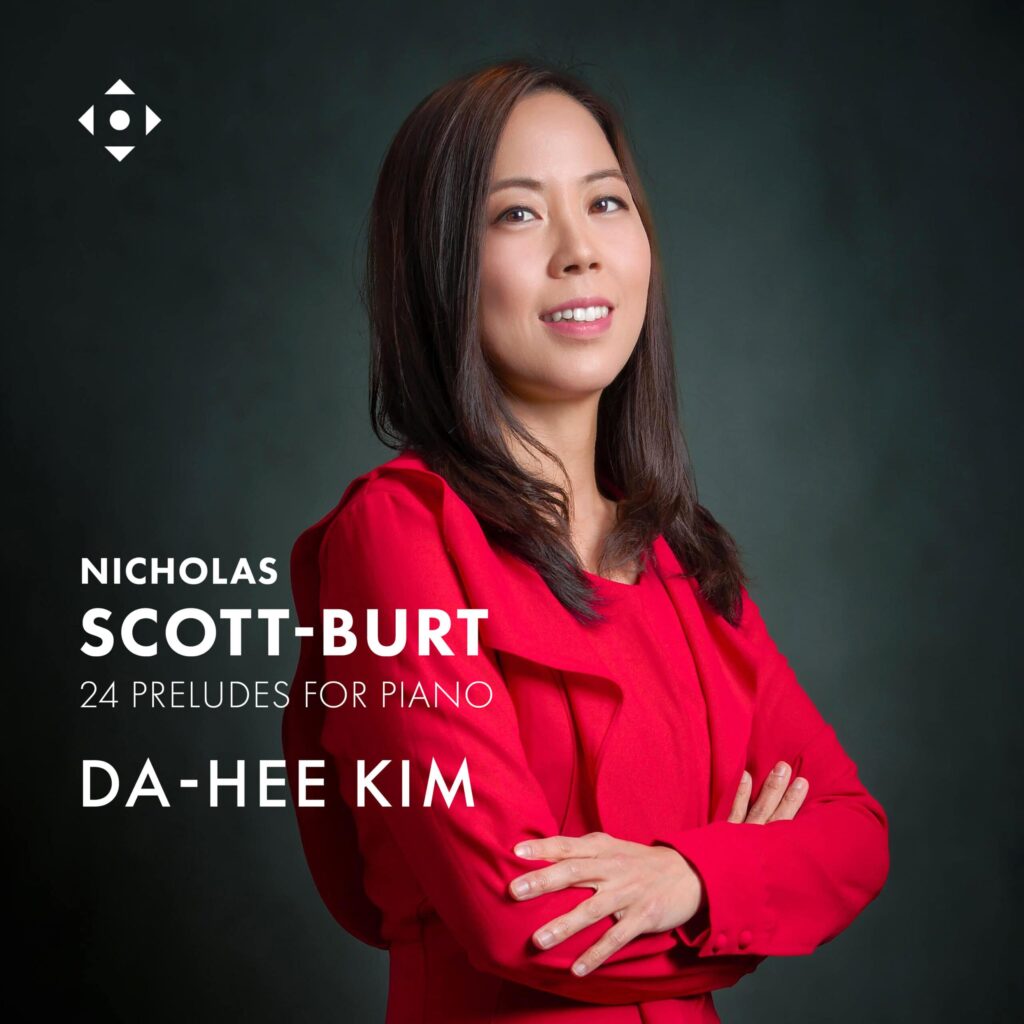
For this comprehensive presentation of his compositions, Bristol-born Nicholas Scott-Burt (b. 1962) couldn’t have asked for a better interpreter than Da-Hee Kim, a charismatic pianist who delivers assiduous performances of his material. After training at the Paris Conservatoire, she studied at Munich’s University of the Performing Arts and acquired her Doctor of Musical Arts degree in piano performance at the Peabody Conservatory. Kim, who also performs with her brother, violinist Da-Min Kim, as Duo Ainos, is currently a pianist at Elmhurst Ballet School in association with Birmingham Royal Ballet.
To say Scott-Burt took to composing early is an understatement: as a primary school student at Reading, he wrote three “operas” before naming an organ sonata, written when he was seventeen, Opus 1. A graduate of the University of Bristol (earning BA, MMus, and PhD degrees), Scott-Burt’s been, among other things, a school music director, choral and orchestral conductor, organist, jazz pianist, and teacher; consistent with that, his music ranges from pop songs, concertos, and symphonic works to choral and church music. His description of the “three main primary colours” that compose his musical style bespeaks a healthy dose of self-deprecation: “neo-classicism (new wine in old bottles), postmodernism (old wine in new bottles), and jazz (never mind the bottles, just drink the wine).” Hints of Scott-Burt’s precursors surface in his music, such that one might as easily encounter a trace of Bach and Purcell as Bartók, Messiaen, Shostakovich, and Prokofiev (jazz too).
In writing a cycle of preludes in all twenty-four major and minor keys, the set, composed between 2019 and ‘20, provides an optimal outlet for his imagination and stylistic interests. By its structural nature, the cycle ensures that cohesiveness results, yet each prelude allows for unlimited creative possibilities. Rather than simply present the work as twenty-four separate entities, he elected to group them into four “books” of six movements apiece, with each group exuding different character: according to his notes, “Book 1 is neat and neo-classical; Book 2 more extravagant and romantic; Book 3 somewhat more introspective; and Book 4 bright and sunny, though with its darker moments.” Interestingly, all but the last of the preludes are compact (one to five minutes at a time), with the twenty-fourth towering over the rest at sixteen minutes.
Recorded at St George’s Concert Hall in Bristol during 2025, the 105-minute release offers an in-depth portrait of Scott-Burt’s compositional artistry and Kim’s terrific abilities as a pianist and interpreter. The cycle begins with a lyrical C major prelude whose entrancing four-note patterns draw one into the music immediately; Kim’s nuanced execution is also a key reason for the music’s impact. A hint of “God Save the Queen” seems to emerge at the outset of the D minor second, though it quickly leaves that behind for a delicate and dignified exercise in melancholia. Ascending chords instantly differentiate the D flat major third from the first two, as do the three different key signatures Scott-Burt weaves into the material. Whereas the brief E flat minor fourth is memorable for the fury of its cluster chords, the slightly longer D major fifth engages for its serenity and delicate interlacing. More haunting still is the baroque-styled E minor sixth, Bach again evoked before the music blossoms into a fugal mini-odyssey and enigmatic exploration. Pounding chords lend the E flat major seventh an imposing, grandiose character, classical minimalism hinted at in the ostinato patterning. Speaking of enigmatic, there’s the shadowy eighth prelude in F minor, with jazz harmonies sneaking in through a side door. The E major ninth, on the other hand, exudes a tender, chorale-like hush that at moments echoes Ravel. The “violent downpour” that is the F sharp minor tenth definitely calls on Kim’s dexterity, but she’s more than capable of meeting its challenges.
Jumping to the thirteenth (in G flat major/F sharp major), a hint of Wagner emerges in its chromatic language, while the G sharp minor fourteenth dazzles with rapid-fire octatonic patterns. Anticipating Minimalis I, the G major fifteenth exudes a lyrical urbanity whose dreaminess, especially when executed with Kim’s exquisite touch, calls Keith Jarrett to mind. The A minor sixteenth is noticeably solemn by comparison—a ponderous prelude for a rainy day, one might say. The A flat major seventeenth is, in the composer’s words, “an exercise in mensuration canons … in which the staggered superimposed melodies move at different tempi.” The intricate result proves fascinating in the way different strands of melody harmonize and how tension emerges to amplify the dramatic effect. Flirting with atonality is the B flat minor eighteenth, the dreamy A major nineteenth minimalism, and the B minor twentieth an elegant three-part waltz progression. Scott-Burt’s jazz side flowers within the B flat major twenty-first, Kim again bringing his music vividly to life with a passionate rendition. After the intense fugue that is the C minor twenty-second and the ominous, pointillistic twenty-third, we reach the C sharp minor finale, an encompassing travelogue that revisits each of the previous twenty-three. Scott-Burt’s preludes manifest dramatic shifts in mood and style from one to the next, some pensive, others exuberant, but all testify to the fecundity of the composer’s imagination and scholarship.Supplementing the primary work are Minimalis I and Love Song (both 2016), which add significantly to the release. The former is a five-sectioned, symphonically structured adventure that advances from its opening dissonant chord to chordal examinations, melodic variations, and tempo shifts before reaching its well-earned resolution with a restatement of the opening chord. Ending the recording with the romantic Love Song—composed by him with no particular recipient in mind—was a smart move on his part for the eloquence with which it concludes the release. For those desiring the deepest possible dive, detailed notes by Scott-Burt for the preludes and the others appear in the release booklet (in some cases, ultra-detailed, the G minor twelfth a case in point). Space considerations prevent an equally deep dive from appearing here, though hopefully a solid overall impression of the material has been provided. All things considered, a recording well worth one’s time, for both the pieces presented and the performances thereof.