





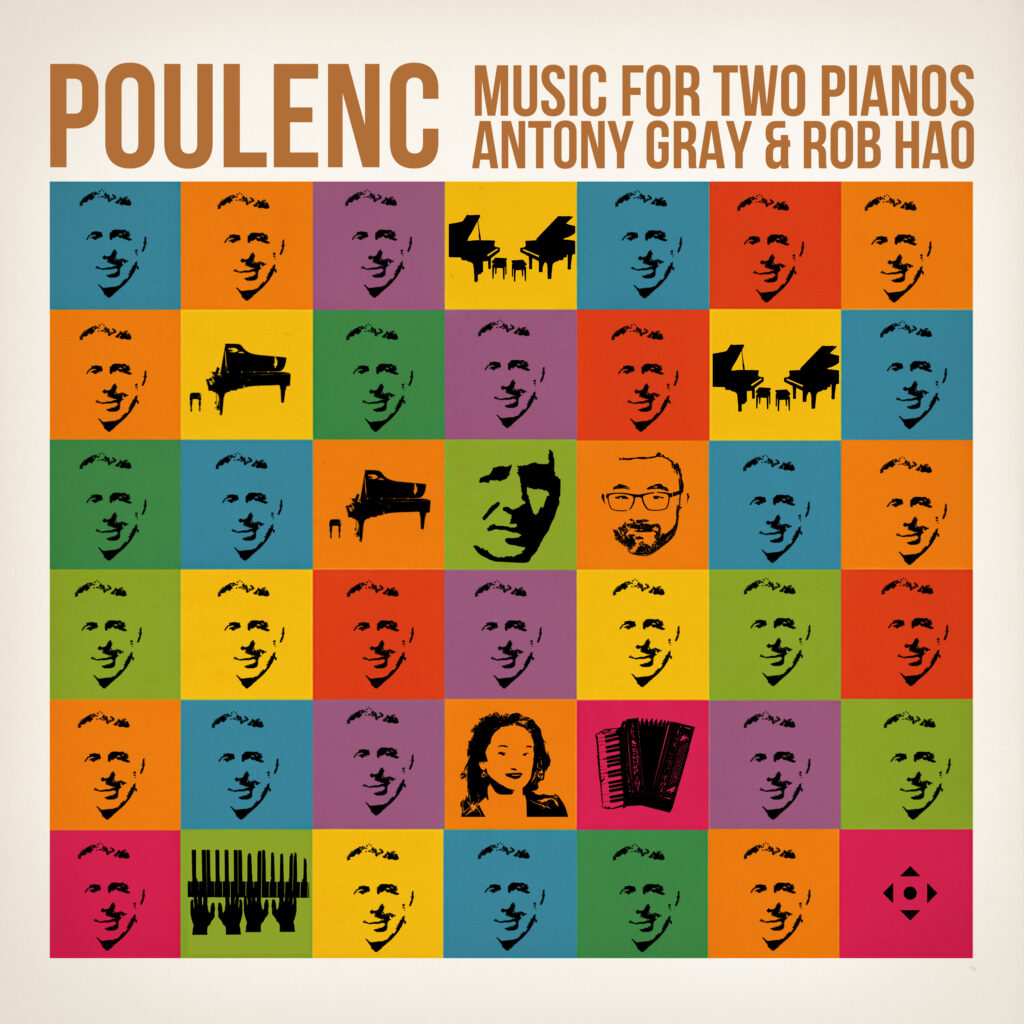
Here is a delightful album which, for reasons I shall come to, I suggest no Poulenc devotee can afford to miss. The Australian duo of Antony Gray and Rob Hao have assembled a comprehensive survey of all Poulenc’s music for two pianos (except for the Concerto) on a single album, with three other works available as digital-only bonus tracks: the early Sonate pour piano à 4 mains, written when Poulenc was just 19; the Capriccio for two pianos (his own transcription of the finale of his cantata Le bal masqué); and the Valse de musique de soie for solo piano, performed by Antony Gray, a work rediscovered as recently as 2017.
They begin with arguably Poulenc’s best-known work for the medium, L’embarquement pour Cythère, which sets the tone for much of what follows (“Don’t analyse my music,” he wrote. “Love it!”). Gray and Hao are manifestly in the zone, beautifully recorded, relishing every quirky twist and turn that the Gallic charmer presents them.
Next we have the first of this album’s USPs: the first recording of Poulenc’s own piano reduction of his Concert champêtre, interesting but not necessarily an improvement on the original work written for harpsichord. That is followed by Élégie, one of Poulenc’s final keyboard works, and then the Sonata for Two Pianos, his most significant contribution to the medium. It’s a fine performance, though the American duo Robert Fizdale and Arthur Gold (for whom the piece was written) take a livelier view of the Allegro molto second movement, though of course not in such good sound.
Then we come to the work that Poulencians (Poulencists?) will want to hear: his lost score for a 1951 film entitled Le voyage en Amérique, the story of a couple from rural France taking their first-ever flight, and starring Yvonne Printemps in her final role. The soundtrack was scored for two pianos. Antony Gray tracked down a copy of the film and, as a way of recovering the score, transcribed it himself. This is its first commercial stand-alone recording.
To complete the transcription of the soundtrack, Gray also includes one of two songs composed for the film (“Adieu maison,” with soprano Helen Miles), and a Valse for two pianos and accordion (Alise Silina). You might recognize it—an earlier version of the piece that opens the album.
The 16 separate short (sometimes very short) cues make for a disjointed, rather unsatisfactory listening experience, but many of them are instant earworms. The fecundity of invention, drawing on a range of genres from classical to music hall, is astonishing, each cue unmistakably by the composer of Babar the Little Elephant.
All in all, une grande fête for le petit maître.