








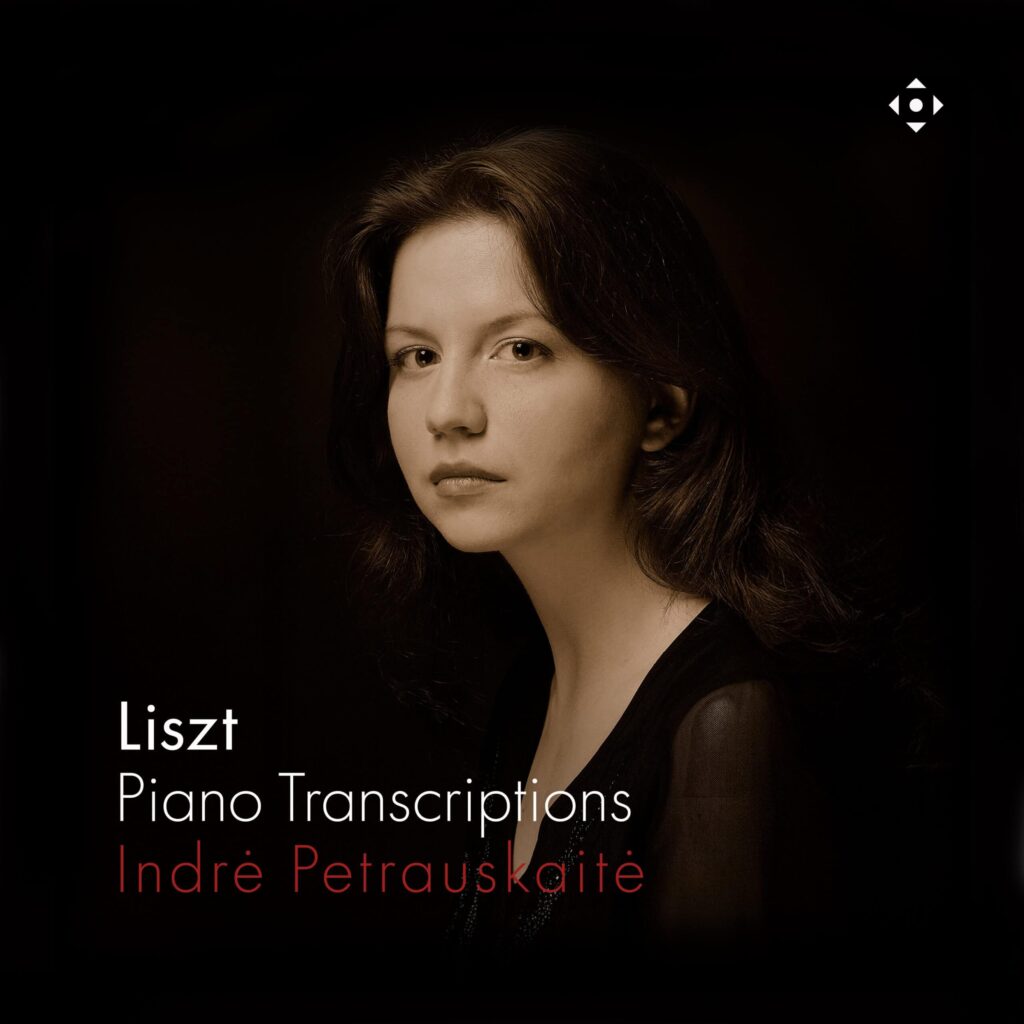
I’m glad that this charming recital of Liszt transcriptions, which was recorded in 2007, has made it into print. I was unacquainted with Lithuanian pianist Indrė Petrauskaitė, but she’s technically impressive. Lacking much specific biographical detail, I gather that Petrauskaitė was finishing her advanced studies around this time. In any event, the side of Liszt’s vast output devoted to transcribing the music of other composers is often disarming, and he was particularly noted for bringing Schubert’s Lieder to a wider public that might have undervalued them. The wide swath of transcriptions that Petrauskaitė presents covers a range of ambitiousness from the modestly literal to the bravura virtuosity that dominated Liszt’s reputation as a performer.
Central to Petrauskaitė’s appeal is her limpid touch and lyrical sensitivity to the Schubert group, the largest one here. Some readers are old enough to remember when there was a wide gap between Schubert’s “pure” art and the carnival that Liszt brought to town, a gap that prevented all but a few pianists from venturing into this repertoire. I think back to CDs by Lazar Berman and Frederic Chiu that crossed this line. With today’s laissez-faire attitude, however, it is possible for Alexandre Kantorow, in his Carnegie Hall debut after winning the Tchaikovsky International Competition in Moscow, to feature Schubert-Liszt transcriptions—the program was duplicated on a 2024 recital disc on BIS, which overlaps with Petrauskaitė in two songs, “Der Müller und der Bach” and “Frühlingsglaube.”
Kantorow approaches them as meditations on subtle emotional states, and he possesses the nuanced touch and personal presence to make his case. Petrauskaitė is by no means far behind, and in “Der Müller und der Bach” she is slower and more reflective than Kantorow, even though her touch isn’t as refined. She isn’t afraid, moreover, to “play big,” as she demonstrates in the one Liszt transcription that has become an encore cliché, Schumann’s “Widmung.” She gives it a rich-toned treatment without reaching the song’s climactic grandeur too soon, a common fault. The recorded sound, which focuses on providing a resonant bass, is her ally.
In his late years Horowitz brought high visibility to Isoldes Liebestod, but I felt he leaned too heavily on the tremolando in the left hand that substitutes for sustained string tone in the orchestra. It’s a tricky balancing act, and Petrauskaitė starts out unpropitiously by banging on the opening chords. But frankly, Liszt’s attempt to imitate Wagner’s orchestral sonority is futile, and I applaud Petrauskaitė’s approach, which is to regard the melody as a song rather than a grand aria. Her delicate phrasing is captivating, showing a genuine lyrical gift.
As for limitations, Petrauskaitė’s rhythmic sense can be foursquare, as at the beginning of Senta’s Ballad from The Flying Dutchman, where both hands seem to churn. When it is necessary to transcend Liszt’s arrangement, as in “Der Doppelgänger” from Schwanengesang, in order to reach the emotional depth that a great Lieder singer can impart, Petrauskaitė gets an honorable mention compared with Kantorow’s mysterious and moving “Die Stadt” from the same song cycle.
Petrauskaitė doesn’t occupy a charisma-free zone, but this recital isn’t a star turn. While lacking the last ounce of panache, she is thoroughly musical. Bigger names haven’t done as well in this material, which Petrauskaitė successfully uplifts beyond the genre of working transcriptions.