








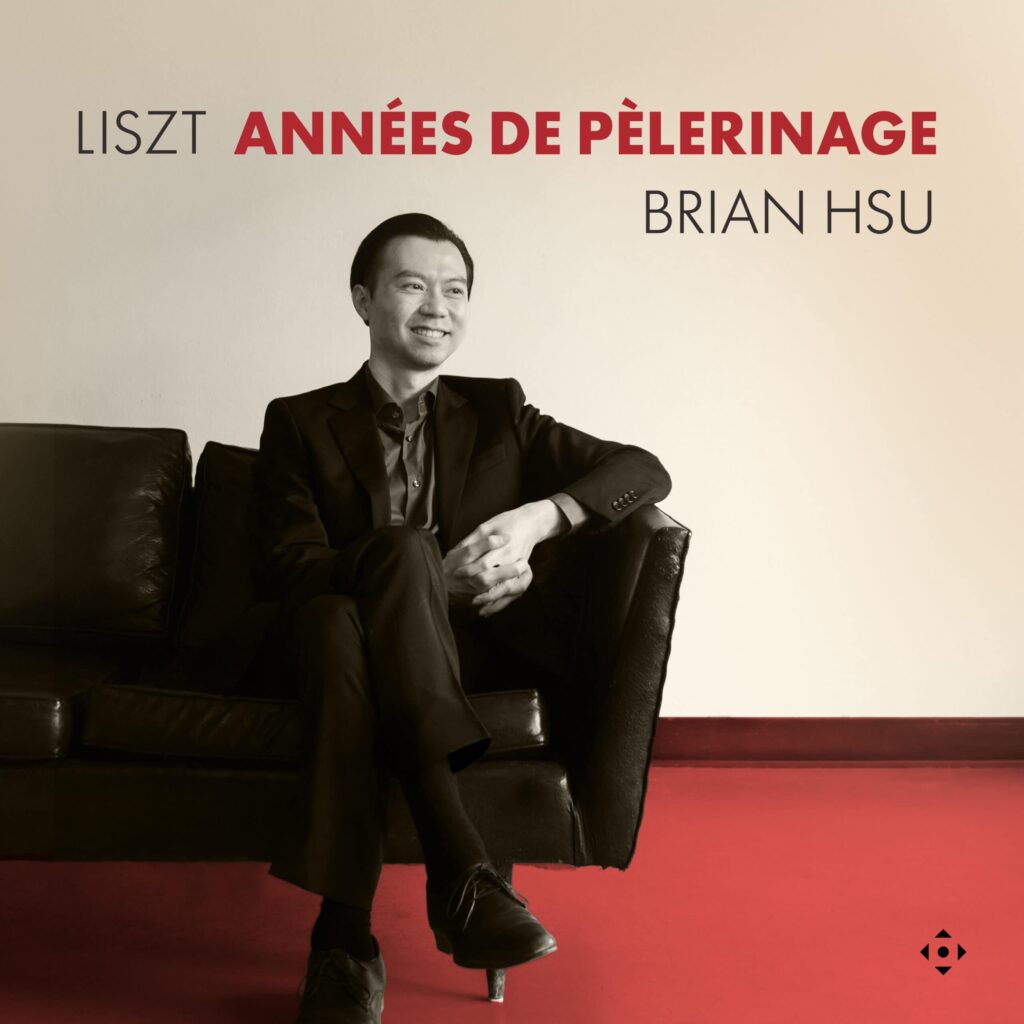
Années de pèlerinage (which means years of travel rather than pilgrimage) is one of the largest of Liszt’s collections: three books, with a supplement to the second. As with many of his works, the individual books went through several stages of revision. What we normally hear, as we do on this recording, are the final versions.
The inspiration for the first book came from Liszt’s travels in Switzerland with the Comtesse d’Agoult, which led to a collection Album d’un voyageur. He withdrew it when in 1855 he published the definitive version as Années de pèlerinage, Première Année, Suisse. The inspiration for the second book was Liszt’s stay in Italy with the same lady. The whole book did not appear until 1858 as Années de pèlerinage, Deuxième Année, Italie. Again, there were earlier versions of some of the pieces. The third book, also Italie, from many years later, contains pieces written between 1867 and 1877, and was published in 1883.
As a generalisation, one could say that the Swiss book deals mainly with landscape and the first Italian book with works of art. The second Italian book is framed by religious issues. There is some unevenness of inspiration across all these works, but the whole represents a great achievement, and has been deservedly popular with pianists. Although some of the pieces require considerable virtuosity, the emphasis is on the romantic and poetic aspects of Liszt’s inspiration. Many of the pieces bear epigraphs from poets, notably Byron.
Pianist Brian Hsu, an American of Taiwanese background, is currently Associate Professor of Piano at the University of Oregon. He has performed widely. He says that he immersed himself in the Années de pèlerinage during the Covid lockdown, travelling in imagination through Switzerland and Italy when he could not do so in person. He then became drawn into the inner world of the third book.
The Swiss book opens with the Chapelle de Guillaume Tell, the Swiss national hero. One can hear the calls to arms sound through the valleys and build to a big climax, adroitly handled by Hsu. Au lac de Wallenstadt is a tuneful number over a rippling bass, and the Pastorale is somewhat similar, this time with a rocking bass. In both, I admired Hsu’s delicacy of touch and his careful but not pedantic differentiation of semistaccato from slurred passages in the Pastorale. Au bord d’une Source is cunningly written. with the hands crossing to shape the tune; of course, this cannot be seen on a recording, but it makes for a distinctive sound. There are three short cadenzas of the fast, delicate kind.
Orage is a storm scene, with lots of pounding octaves; it is perhaps less interesting than its predecessors. Vallée d’Obermann is the longest work in this book. It begins well and goes through a whole range of moods with some very forceful writing. Hsu copes well, but I feel the piece is too long for its material. Eclogue is another successful short piece with plenty of opportunity for delicate playing. Le mal de pays sounds as if it is based on a folk song; it moves through a succession of moods in its short span. Les cloches de Genève is an early attempt at a kind of piece that Liszt tackled more successfully in the third book.
The first Italian book begins with Sposalizio, inspired by Raphael’s The Marriage of the Virgin in Milan. The main theme is poetic, and then there is an interlude, at first rather Schubertian and then in a chorale. The first theme returns, and there is a long climax with the original rippling theme in the bass in octaves. All this is nicely managed by Hsu, and he is particularly good in the opening and the closing dolce passages. Il Pensieroso was inspired by one of Michelangelo’s sculptures in the Medici chapel in San Lorenzo, Florence. It is an impressive and sombre piece, with some adventurous harmonies (they might have suggested the sleep motif in Wagner’s Die Walküre).
In contrast, the Canzonetta del Salvator Rosa is light and cheerful. It is based on a well-known tune, not in fact by the painter named. The three Petrarch sonnets were indeed originally songs, though the piano version made at the same time is done so expertly that you would not have known their origin. Liszt prints the texts of the sonnets above each piece and gives their numbers as 47, 104 and 123, though in modern editions they are 61, 134 and 156. These are lyrical pieces but with virtuoso passages and cadenzas, which Hsu despatches with fleet fingers and delicacy. This book ends with the Dante Sonata, or rather, as Liszt titles it, Après une lecture du Dante: Fantasia quasi Sonata. He had been reading Dante with his countess, but I suspect that when he wrote this piece he had not got further than the Inferno, so full of gloom and terror it is. This actually rather long and rambling piece has many impressive passages, which Hsu holds together as best he can.
The Supplement to the second book, Venezia e Napoli, consists of three pieces, In this version it dates from 1859. These three are all rather lighter than works in the main book, and are all based on songs by other people. Gondoliera has a swinging tune in 6/8 and two cadenzas. Canzone is based on a melody from Rossini’s Otello, delivered over a tremolo bass, an effect Liszt was fond of. The Tarantellagoes at a furious lick, again with cadenzas of much intricate writing. Hsu delivers all this with style.
By the time of the third book, Liszt had abandoned the virtuosity of his youth, and developed a stark and austere style. This, we hear in the first piece, Angelus, a devotion to the Virgin Mary, said three times a day, prompted by the ringing of a bell. The work begins by evoking the bells Liszt heard in Rome, but the bulk of the piece develops a simple theme, sometimes just in single notes. Next come the two Threnodies evoking the cypresses of the Villa d’Este. These are fine though sombre pieces; the second begins as if is going to be a fantasia on the opening of Tristan und Isolde. Les jeux d’eaux à la villa d’Este is the best-known work in this book. Its evocation of water influenced later composers, notably Ravel in his water pieces. At its centre, however, Liszt places above the notes a quotation from St John’s Gospel, which in English reads ‘but the water that I shall give him shall be in him a well of water springing up into everlasting life’.
The last three pieces return us to the melancholy mood. The title of Sunt lacrymae rerum (there are tears in things) is a line of Virgil, Aeneid I. 462, referring to the dead of the Trojan War. Liszt associated it with the Hungarian War of Independence of 1848-1849. The Hungarian mode of the subtitle is the harmonic minor mode with a raised fourth note. The Marche funèbre is for Emperor Maximilian I of Mexico, executed by revolutionaries. Sursum corda (lift up your hearts) takes its title from the Preface to the Canon – consecration prayer – of the Mass. It begins quietly but works up to the largest climax in the collection, notated on four staves, before ending surprisingly with massive chords of E major.
I have mentioned Hsu’s sympathy with the pieces in this third book. Strange, sometimes forbidding, they eschewing the natural charm of the earlier books. They are perhaps not entirely successful but nevertheless impressive.
There are, of course, many other recordings of the Années de pèlerinage, some of the complete set, some of one book only. Brian Hsu is a committed and reliable guide. If you choose this set, you will not be disappointed.