








Woodwind Orchestra is an ensemble of woodwind instruments only, meaning with saxophones but without horns. Such ensembles began in central Europe around 1750 with instruments that were usually paired, playing in groups of 5 to 8, though they reached sizes much larger on occasion. Among the earlier examples is the Serenade for 31 wind instruments from 1779 by Spanish-Austrian regional court official and violinist-composer Juan Carlos de Ordonez, an early member of the Viennese Society of Musicians from June 1771, shortly after it had begun in April. These groups played outdoors as well as inside. Handel’s Music for the Royal Fireworks in 1749 was of this ilk though using trumpets, horns, and percussion. Much more information is available at the Woodwind Orchestra Online Portal, woodwindorchestra.com. There may be such an ensemble near you. For example, American saxophonist and conductor Logan Barrett has founded the Middle Tennessee Woodwind Orchestra for the Nashville area. English conductor, composer, clarinetist, and arranger Shea Lolin led the Bloomsbury Woodwind Ensemble of London, founded in 1993, from 2005 to 2021 while commissioning and preparing performances of 15 new works.
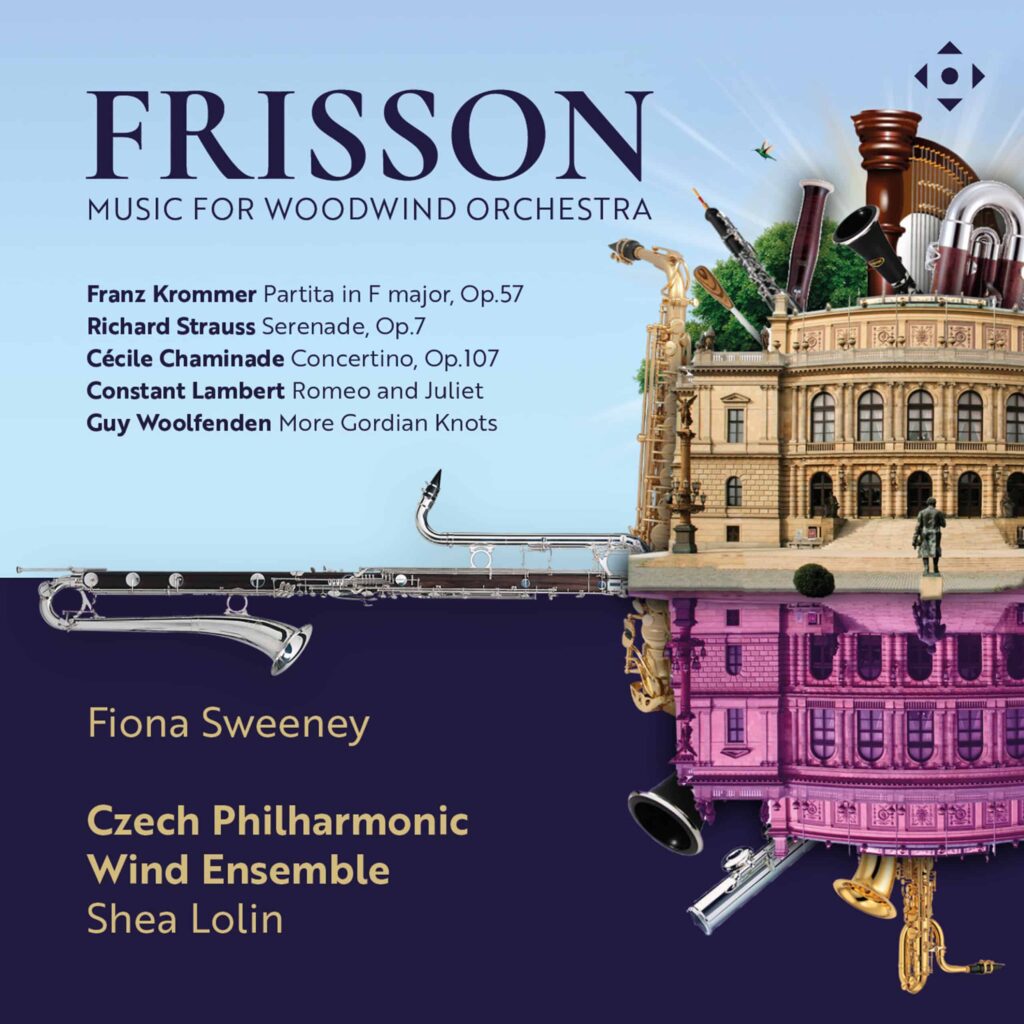
There are three albums now that present some of them. It was in 2014 that Legni gave us Twisted Skyscape (M/A 24, p. 150) with pieces by Gary Carpenter (b. 1951), Philip Sparke (b. 1951), Adam Gorb (b. 1958), and Christopher Hussey (b. 1974). This release was followed by Chromosphere with a similar program from Divine Art (J/A 24: new). All arrangements, the selections here are the Partita in F, Op. 57 (1806) by Franz Krommer, Serenade in E-flat, Op. 7 (1881) by Richard Strauss, Concertino in D, Op. 107 (1902) by Cécile Chaminade, written for flute and piano originally, a suite from the ballet Romeo and Juliet (1925–26) by Constant Lambert, and More Gordian Knots (1995/2010) by Guy Woolfenden, written for clarinet choir in its first form and adapted by the composer.
My expectation for what to hear was high because of Bohemia’s long history of providing wind players across the continent—but especially to Vienna nearby—and in particular the euphonious Serenade in D minor by Dvořák. These Czechs sound gorgeous. There is excellent balance from treble to bass, clarity, and contrast to both the playing and recording. Superb intonation indicates the pinnacle of woodwind playing.
Seeing Timothy Reynish among the backers of this recording would not rescue it if it were a dud. Many more had faith in Lolin’s project too. Consider me converted to the cause.