








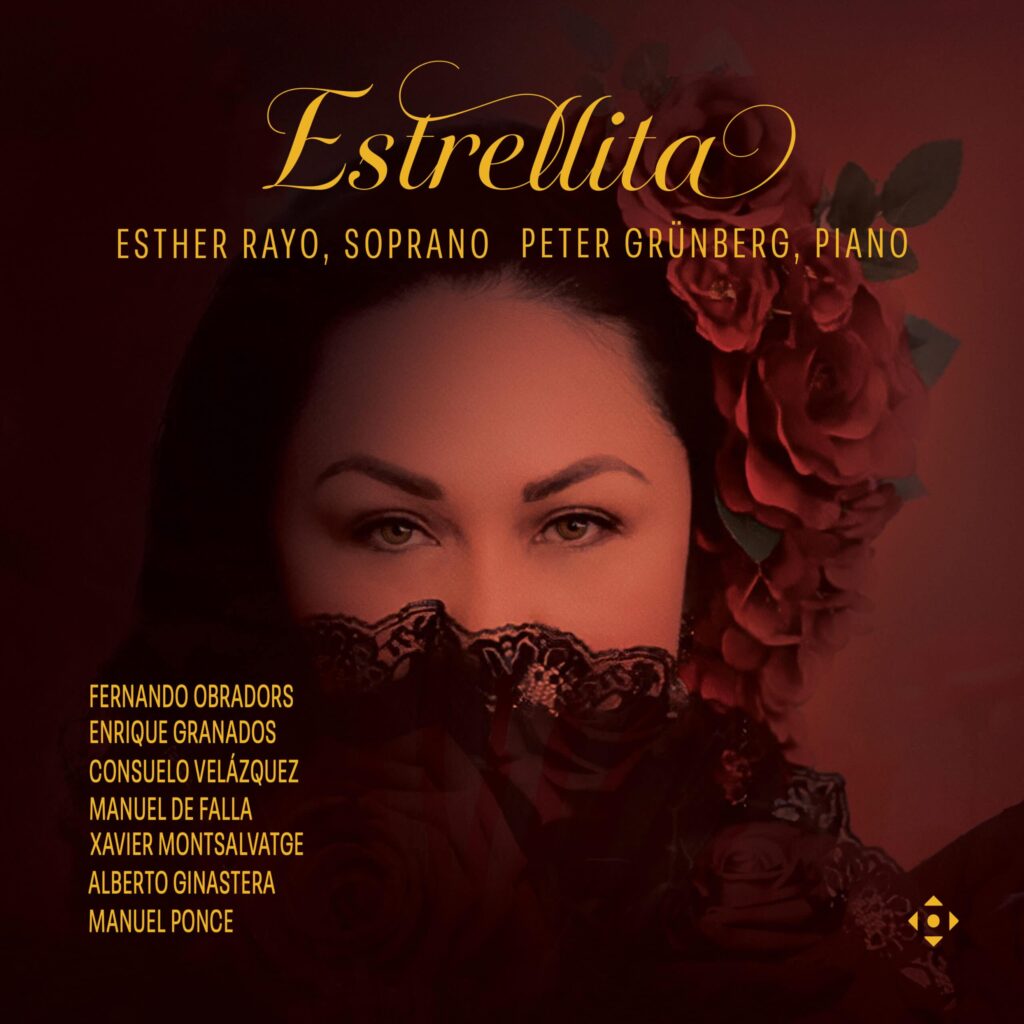
California-born lyric soprano Esther Rayo sings with exceptional poise on this sumptuous collection of Spanish and Latin American canciones. It’s easy to embrace the warmth, lustre, and smoothness of her voice, and that she delivers her renditions with such authority and emotional conviction makes Estrellita even more appealing. With renowned Sydney-born pianist Peter Grünberg by her side, Rayo makes her debut recording with him a special one indeed. Though she wasn’t born in Spain, she grew up surrounded by Spanish music and language and thus developed a natural affinity for the music. That feeling only intensified when she discovered the music of Manuel Obradors at college (she’s a graduate of Sonoma State University and DePaul University), which in turn led to a deeper engagement with Spanish art song. That passion is captured on Estrellita, which features songs by Obradors, Manuel de Falla, Enrique Granados, Alberto Ginastera, Xavier Montsalvatge, Consuelo Velázquez, and Manuel Ponce.
Carrying on the traditions associated with figures such as Schubert and Schumann, Spanish composers aspired to uphold their predecessors’ penchant for melodic richness and maintain the conversational relationship between singer and accompanist; that they had such a strong folk tradition to draw upon also helped ensure their songs would register powerfully. Obradors’ major claim to fame are his seven books of Clássicas canciones españolas, of which the recitalists present five from the first volume to open the recital. One is instantly transported by the lamenting character of “La mi sola, Laureola” and the vulnerability of Rayo’s pure, expressive tone. Playful by comparison are “Al amor” and “El majo celoso,” Grünberg shining resplendently (as he does throughout) and his partner emoting gracefully. The highlight of the set is “Con amores, la mi madre” for how exquisitely she communicates its tenderness and intimacy. “Del cabello más sutil” isn’t far behind, however, especially when the piano part is so Debussy-esque.
Selections from Granados’ 12 Tonadillas en estilo antigo are next, with three of them carrying the title “La maja dolorosa” (The Sorrowful Woman) and designed to embody the women’s responses to the deaths of their husbands or perhaps lovers. Whereas the heights of operatic tragedy are scaled in the grief-stricken first, the luminous second opts for a more dream-like character and passages that shift from mournful to hopeful. The spotlight shines exclusively on Grünberg when he performs “Quejas, o la maja y el ruiseñor” (The Girl and the Nightingale) from Granados’ Goyescasalone, an inspired move on the recitalists’ part for allowing his pianistic artistry to be independently showcased. In an interesting choice of sequencing, “Bésame mucho” follows, the bolero-styled setting written two decades later by Velázquez as a reply to Granados’ creation (in fact, the first five notes of her piece replicate those in his). How fascinating it is to witness Rayo progress from resignation to defiance with such commanding ease.
Six romance-styled selections from de Falla’s popular Siete canciones populares españolas exude an abundance of charm, be it the touching “Asturiana,” flamboyant “Jota,” or haunting “Nana.” Four pieces from Montsalvatge’s Cinco canciones negras follow, the first, “Cuba dentro de un piano” (Cuba inside a piano) setting a striking tone with its theatrical flair and sensual, habanera-styled inflections. Intoxicating in a different way is the lyrical serenade “Canción de cuna para dormir a un Negrito,” which the recitalists render beautifully. Grünberg, who once performed privately for Ginastera, tackles the composer’s Cinco canciones populares argentinas with missionary-like zeal, Rayo matching his fervour step for step (witness the high-energy percussive acrobatics of “Gato,” for example).Without wishing to downplay the impact or value of the material preceding it, one could turn immediately to the album’s closing song, Ponce’s “Estrellita,” for three minutes that encapsulate everything that makes this recital project so appealing. The song’s sweeping melodic lines, soaring vocal, and assured piano accompaniment combine to argue vehemently on behalf of the material. Grünberg contributes excellent liner notes that enhance one’s appreciation for the composers and their works, but the performances would be little diminished by their absence. Spending sixty-six minutes in the company of him and Rayo proves to be time extremely well spent.