






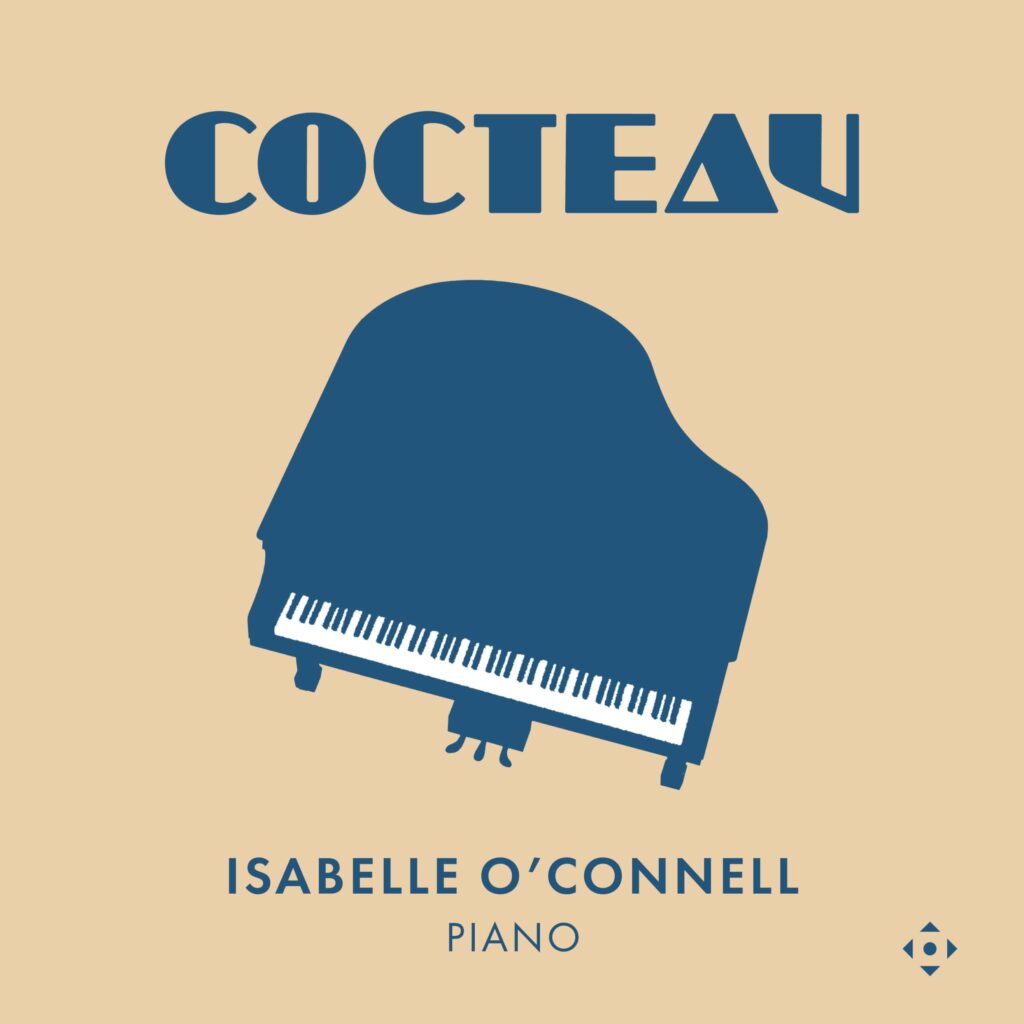
This album was born from a Covid-time collaboration between pianist Isabelle O’Connell and composer Rhona Clarke, whose idea was to compose a set of pieces based on the drawings of French artist, filmmaker, novelist, and poet Jean Cocteau. For O’Connell, the obvious way to premiere this suite was alongside music by other composers inspired by Cocteau, which meant the music of Paris in the 1910s and 20s. The end result is an intriguing programme of some familiar and some unfamiliar pieces, alongside Clarke’s 26-minute piece, simply called Cocteau.
We kick off with the Erik Satie Rag-Time Parade from his 1917 ballet collaboration with Cocteau. I was, as they say, “today years old” when I discovered that it is an adaptation from Irving Berlin (Satie was never shy about borrowing) and O’Connell plays it straight, much in the same vein as Joshua Rifkin playing Joplin. Of the other Satie, the three Gnossiennes are very slow and statuesque, a very justifiable aesthetic interpretation, even if I prefer them to have some forward momentum. (The more famous Gymnopédies are included as a digital bonus, played in much the same way.) Rêverie de l’enfance de Pantagruel, originally an orchestral piece written for a Cocteau-organised concert, is not something I’ve heard before, O’Connell channelling Satie’s inscrutability well.
Of other composers in Cocteau’s orbit, we have Stravinsky’s Les Cinq Doigts, which is Igor at his most Satie-esque. These little pieces, supposedly for children learning the piano (has a child learning the piano ever played them?), have a faux-naïveté which O’Connell captures perfectly, not least in the penultimate “Vivo”. The Ragtime is a most peculiar thing if viewed as ragtime – the composer later called it “a concert portrait or snapshot of the genre” – and it benefits from O’Connell’s dancing whimsy.
Cocteau was the ringleader of the group of young Parisian composers dubbed “Les Six”. O’Connell next presents L’Album des Six, a book of short piano pieces, their only collaboration as a group. Perhaps the most striking pieces are Poulenc’s Cubist Valse and Germaine Tailleferre’s harmonically elusive Pastorale. Her the three miniatures earlier in the programme are also exquisite.
And then we get to Rhona Clarke’s suite. I had previously known her as a choral composer – her 2022 album Sempiternam is very good – but she started out as a pianist. The music of Cocteau is very unlike the music elsewhere on the album in its language, although it shares a mercurial and quirky quality. The pieces are more reflective and dense, not musically allusive, but deeply felt. “Antigone” has brooding chords amid fluttering decorations, the two movements called “Portrait” explore the vulnerable side of Cocteau, “Blood of a Poet” is an uneasy moto perpetuo and the cycle ends with “Oedipus”, an energetic and dramatic conclusion. Cocteau is a carefully put-together programme, with an excellent booklet and striking cover image, reflecting a successful composer-performer collaboration. Credit to Contemporary Music Centre in Dublin for bringing it about.