





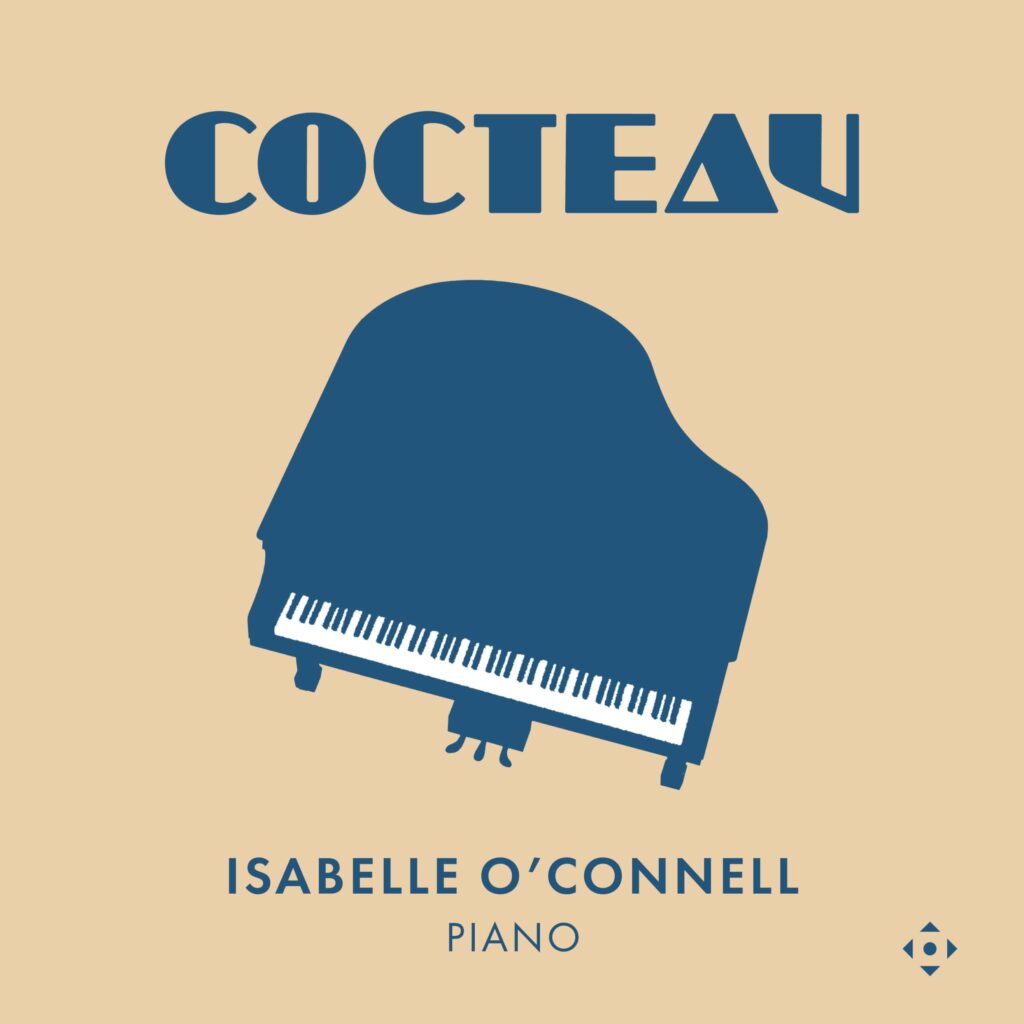
Currently on the piano faculty as Artist-in-Residence at New York’s Bard College, Franco-Irish pianist Isabelle O’Connell has worked with a who’s-who of contemporary composers, from Missy Mazzoli and Julia Wolfe to John Adams and Donnacha Dennehy. Her unwavering commitment to new music is upheld on Cocteau in its premiere of Irish composer Rhona Clarke’s 2022 titular work; it also, however, documents a particularly fertile period in twentieth-century French culture in presenting material by contemporaries of Cocteau (1889-1963). Pieces by Satie, Stravinsky, and Les Six members Georges Auric, Louis Durey, Arthur Honegger, Darius Milhaud, Francis Poulenc, and Germaine Tailleferre appear alongside Clarke’s twenty-six-minute work, making for a supremely rewarding presentation.
More than six decades after his death, Cocteau’s influence is still felt, as indicated, for instance, by the trilogy of Cocteau-inspired works Philip Glass created between 1993 and ’96 (Orphée, La Belle et la Bête, Les Enfants terribles) as well as Clarke’s own piece, written expressly for O’Connell. As a poet, film-maker, and writer, Cocteau played a major part in the directions the century’s artistic movements took. He admired the simplicity, clarity, and refinement of Satie’s writing and also believed young artists should draw for inspiration from cabarets, music halls, and jazz venues that were injecting so much excitement into French culture. A simple scan of the set-list shows O’Connell fashioned it with such details in mind. She also very smartly decided to place the titular work last, such that the music of Cocteau’s contemporaries sets a grand stage for the new piece.
No account of the century’s French classical music would be complete without Satie, and to that end O’Connell’s included Rag-Time Parade, Rêverie de l’enfance de Pantagruel, and Trois Gnossiennes (Trois Gymnopédies too, though as a digital-only bonus). Stravinsky’s well-represented by Ragtime and Les Cinq Doigts, while pieces by Tailleferre and Milhaud are featured separately and as part of L’Album des Six, which presents works by all of the group’s members. Recorded at St. Peter’s Church in Drogheda, Ireland during October 2024, the eighty-minute album’s a thorough account of the era.
After Satie’s cheery Rag-Time Parade sets an infectious tone, Tailleferre explores a different side via the graceful Fauré-influenced stylings of Pas trop vite. Her heartfelt appreciation Hommage à Debussy, written, naturally, after the composer’s death, and exuberant Très vite likewise offer examples of the composer’s range. As familiar as they are, there’s no denying the enduring charm of Satie’s haunting Gnossiennes, superb models for the artistic values Cocteau endorsed. O’Connell delivers them at a slightly slower and contemplative pace than some pianists but not so much that they feel lifeless and anemic.
Like Satie, Stravinsky was seduced by the sound and style of ragtime, hence his own like-titled riff on the genre. Like every piece created by him, Ragtime instantly identifies as a Stravinsky creation whilst also adhering to the jazzy syncopation of the genre. The miniatures constituting 1921’s Les Cinqs Doigts (subtitled “8 mélodies très faciles sur 5 notes,” or “eight very easy melodies on five notes”) tickle the ear with Russian folk melodies and neoclassical elegance. O’Connell states that “the influence of Satie is obvious,” yet while that might be so the material, be it the touching “Lento” or tango-like “Pesante,” retains Stravinsky’s indelible signature.
After listening to Milhaud’s Le Tango des Fratellini, no one’ll bat an eye at discovering that it started out as background music for a Charlie Chaplin film before its use in a Cocteau ballet. Milhaud’s second appearance, a shadowy “Mazurka,” comes by way of L’Album des Six, the only work on which all six members collaborated. Auric starts things off well with a sparkling “Prélude,” after which Durey follows it with the pretty “Romance sans paroles” and Honegger a ruminative “Sarabande.” Let’s not overlook Poulenc’s jovial “Valse” and Tailleferre’s chiming “Pastorale” either.
The culmination is, of course, Clarke’s Cocteau, whose six parts were inspired by the artist’s drawings but also his charismatic personality and artistic command. Whereas a sketch of costume studies, for example, led to “Antigone” and its flickering flow of pirouette-related dance gestures, the two “Portrait” movements were loosely based on his 1962 self-portrait. The dark chord that opens the first might be construed as an allusion to the startling impact of viewing the pencil-drawn image, which shows the artist at an advancing age; inhabiting a lower register, the ponderous, stripped-down second’s even darker. The ultra-dramatic “Blood of a poet,” “Orpheus,” and “Oedipus” make demands on O’Connell’s virtuosity in their rapid-fire flurries of swirling arpeggios and oceanic clusters.It doesn’t surprise that the album’s a delight.
O’Connell’s playing is never less than terrific, and the programme she assembled engages. The pianist’s decision to augment Clarke’s new composition with others indirectly associated with it was a smart and artistically rewarding decision. The dynamic and stylistic range of the material also allowed her to show how effectively she operates within different contexts.