






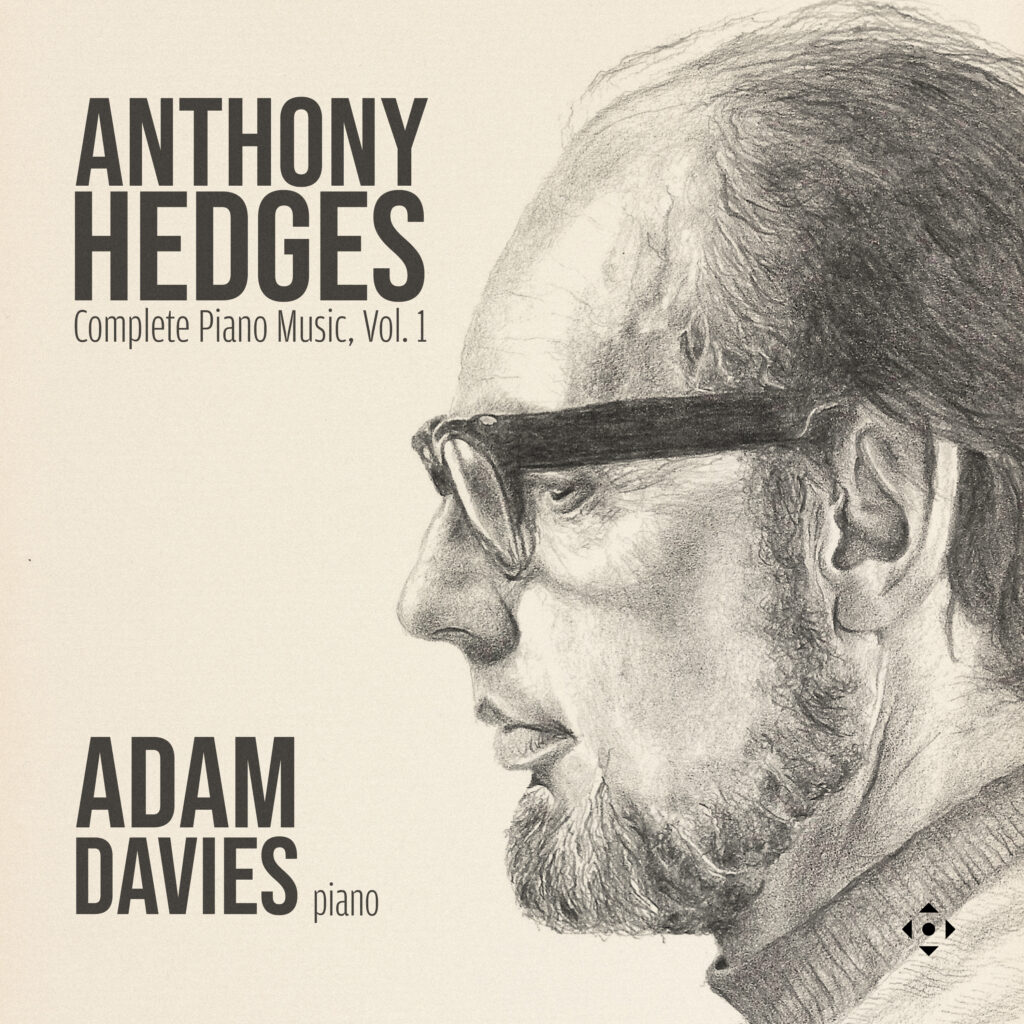
I always feel most encouraged when I see ‘Volume 1’ because it means that we have a performer or group of performers who are allowing themselves to be deeply involved with a particular composer over a period of time. The brilliant and energetic Adam Davies rediscovered Hedges’s piano music during lockdown having already been a vague admirer.
There are to be three volumes, but he admits that this one, which includes a wide range of styles ,which this openly eclectic composer willingly and convincingly embraces, is therefore an ideal place to start.
Recorded in chronological order we open with the Five Preludes Op 5 composed in Scotland in 1959. The language reminded me here, and in other works of his contemporaries of William Mathias with its emphasis or exciting and memorable rhythms, and John Joubert. There are two miniatures, a sparkling Scherzetto written for Ricordi’s ‘Modern Festival Pieces’ for piano in 1963 and Variants Op 11 of 1989. This last work falls into the composer’s educational category aimed at players of Grade 4/5.
We also encounter the Five Concert Pieces for Yong Pianists (1956) which are said to be of a similar standard, and the Six Moods of 1984. Some have been used by examination boards but in many cases the grade marker was underestimated by the composer as there can be quite a number of technical challenges.
Hedges also had a go at embracing twelve tone technique as evidenced in the Four Pieces for Piano(1967). Although this is often a powerful and thought-provoking work, it doesn’t seem to be the real composer, and Hedges realised this as when he came to write a Piano Sonata six years later, he admits to having found the technique ’more of a liability than an asset’.
Even so this is a tough piece in many ways, and is in a sort of cyclic form with the opening chords returning and being used throughout other parts of the work. The use of quartal harmony and bounding rhythms reminded me of Joubert’s 2nd Piano Sonata. The middle movement is curiously fascinating and harmonically unique on the CD.
My favourite work on the disc is the Five Aphorisms of 1990. For me, the composer has now found his real language. If the Sonata is not twelve tone but difficult to pin down, this work captures an equally illusive harmonic language but this time, not with aggression and uncertainty but with an eye on atmosphere and delicate colours and half shades.
Adam Davies has heard recordings of Hedges play some of these works and it does feel that he has captured the mood, particularly here, ideally.
Look out for Volume 2.