








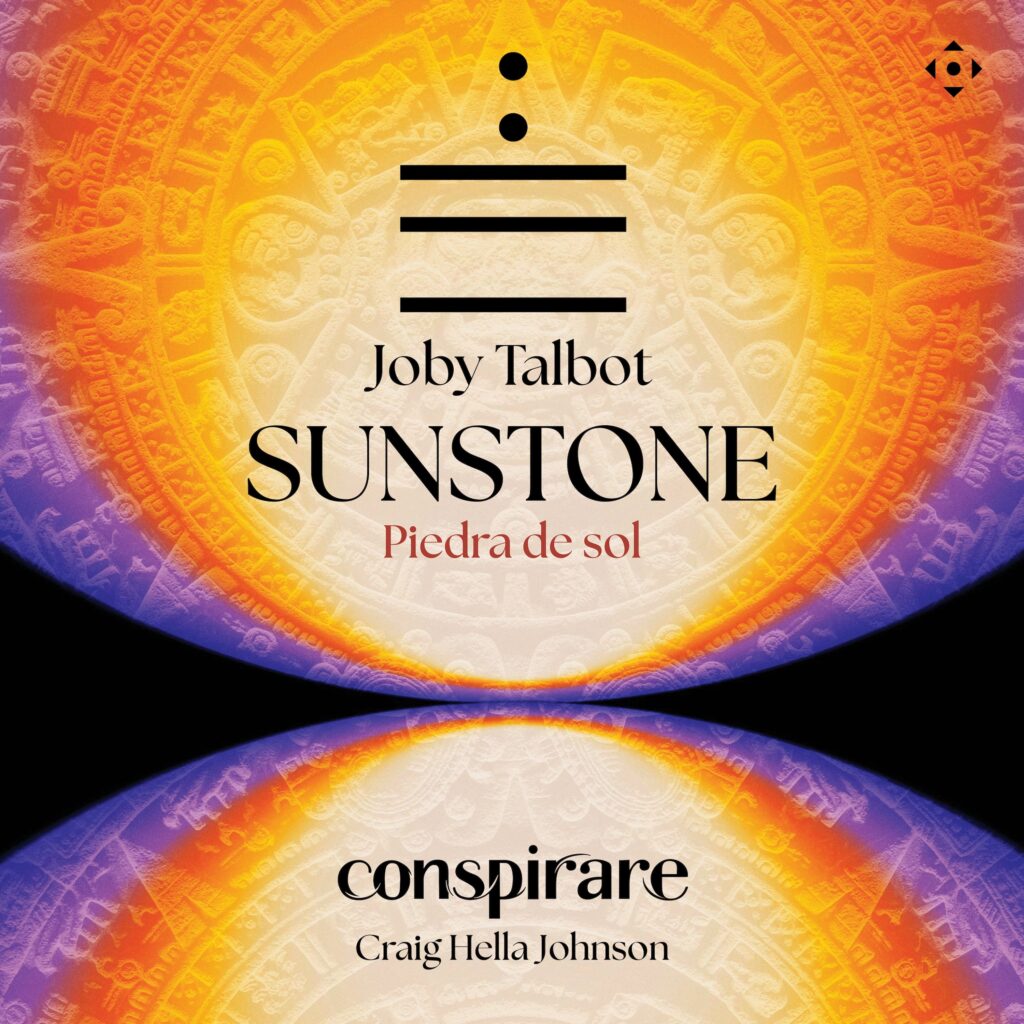
Some degree of risk is involved when a vocal ensemble dedicates the entirety of an album to work by one composer as opposed to pieces by many. In the latter case, a work that doesn’t appeal by one artist can be glossed over when the others do; the former case, however, constitutes a considerably greater gamble. But let’s be clear: any anxiety Conspirare and its Artistic Director and conductor Craig Hella Johnson might have had about devoting its latest album entirely to material by Joby Talbot (b. 1971) can be laid to rest. Their masterful rendering of the London-born composer’s epic treatment of Piedra de Sol (1957) by Mexican poet Octavio Paz (1914-98) is well-nigh definitive, and Talbot’s creation more than justifies the commitment the vocal company made to it.
Advancing as it does through nineteen parts, Piedra de sol (Sunstone) is multi-faceted and thus resists easy pigeonholing. Described as a “surrealist masterpiece” that draws on the symbolism of the Aztec calendar stone, Paz’s poem explores a number of weighty topics, from the cyclical nature of time to creation, love, despair, enlightenment, and salvation. It’s unified by the consistency of the poet’s vision, however, and in Talbot’s mapping of music to words develops methodically until culminating in a stirring affirmation and peaceful resolution. As the vocalists swell to an ecstatic pitch as the travelogue reaches its destination, one is transported by the glorious music the composer created for them.
Many of the singers appearing on the album, recorded in January and March of this year, are known quantities, from sopranos Chelsea Helm, Elijah McCormack, and Savannah Porter to basses Enrico Lagasca and Jonathan Woody. Their names might ring a bell with listeners familiar with Skylark, VOCES8, the Santa Fe Desert Chorale, and The New Consort, and the vocal work they and the others do here is exemplary. Twenty-five singers from around the world contribute to the Conspirare sound, with the ensemble augmented by marimbist Thomas Burritt. A variety of vocal techniques is featured, with an occasional solo turn appearing alongside the full ensemble expression (while the names of the soloists are identified on the booklet page listing the singers, ideally clarification of the one whose solo graces a particular part would have been included too; it would be wonderful, for instance, to know which female singer is responsible for the incandescent solo on “… there is nothing left of me but a gaping wound …”).
Talbot naturally customizes melodies, chants, and rhythms to match the text and reinforce the imagery of a poem that, in repeating its opening stanza at its end, testifies directly to its core theme about the cyclical nature of time. Notes by him further enhance appreciation. He clarifies, for example, that while every line adheres to an eleven-syllable structure, the work, structured in three sub-sections, Creation, Despair, and Salvation, avoids sounding repetitive when stress patterns for each line constantly change and give the work a propulsive, restless energy. Also facilitating the listener’s appreciation is the line-by-line presentation in the release booklet of the poem in Spanish and English.
The enrapturing effect of Conspirare’s vocalizing is evident the moment “… a crystal willow, a poplar of water …” introduces the work and remains firmly in place until the same-titled movement resolves it seventy minutes later; the lulling motion of the voice patterns likewise dovetails with the cyclical concept during this towering opening statement. Movement’s always present, even if as a subtle underlying current, which animates the performance with insistence and urgency. Moments of agitation and high drama emerge too, but they’re balanced by episodes of calm and serenity. Burritt’s woodsy marimba complements the vocalists, even if its ethereal sounding is more a subliminal than overly conspicuous presence. Despite the large number of singers taking part, clarity of articulation is never an issue, and the contrapuntal shimmer of the vocal parts smoothly gathers into a glorious tapestry.As mentioned, presenting a single, long-from work on an album carries with it some degree of risk, but Craig Hella Johnson presents a compelling argument for doing so. In opting for it over short pieces, he and the ensemble afford the listener an opportunity to fully immerse into the sound universe conjured by Talbot and benefit from the satisfactions that accrue from that experience. For seventy minutes, one is able to wholly surrender to its musical odyssey and be dazzled by its magic. Piedra de sol (Sunstone) makes for an excellent addition to a robust discography comprising seventeen commercial albums and twenty self-produced live sets.