








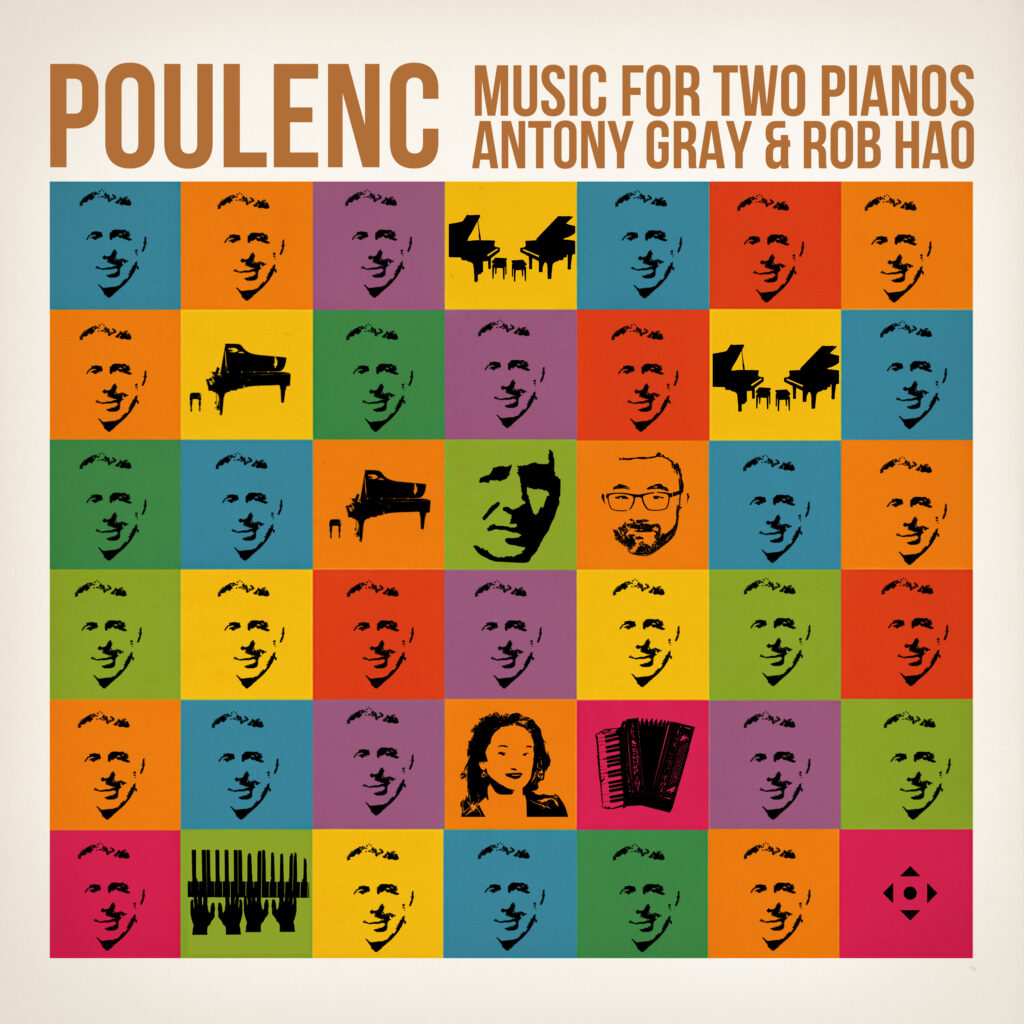
An important strand in Poulenc’s cultural context was a deep admiration for popular music, whose directness and bodily energy his generation believed rose above the moral quandaries surrounding art. Antony Gray and Rob Hao know when that spirit is called for in Poulenc’s two-piano compositions. Poulenc’s unflinching zest for life is audible in every movement, and his signature dissonant chords, carefully voiced, are ever present. Calm is rare: the Élégie has gentler passages but veers into exuberance, and only the third movement of the Sonata for Two Pianos sustains serenity.
The Concert champêtre opens with glorious, thick dissonances that the duo plays wholeheartedly, then moves through a variety of melodies, tending to stay big and loud. Gray and Hao are well-timed in the unison passages Poulenc folds in. The second movement contrasts, slow and stately rather than gentle, and builds to a lovely, courageous main theme, like someone declaring their love without reservation. The third movement is speedy, like a ball rolling down a hill; in its inspired final minutes, which include contrapuntal passages, the two musicians maintain their ease. Ensemble coordination is more demanding in the Sonata for Two Pianos, with its many pauses, tempo changes, and dramatic dynamic shifts. Opening a sonata with a prologue is a rare and intriguing choice: in this one, clangorous chords soon clarify into a chordal introduction, like the start of a drama. In the Allegro molto, phrases waver between confident drive and nervous chatter, turning quixotic in the contrasting middle section with an air of delightful mystery, and Hao and Gray play all of it solidly. The third movement is warm and lyrical, as its title promises, and its lovely final minute evokes distant bells, which the duo captures well.
Le Voyage en Amérique, which Gray transcribed from the soundtrack of a 1951 film, is a long collection of short character pieces, many of them dance tunes with a “ragtime” feel as Europeans imagined Black American music: melodic directness, syncopation, and oom-pah accompaniment. This purposely light music could serve as background for a space or event. The non-descriptive titles leave listeners free to decide what each track means. The final movement surprises with an accordion part played by Alise Siliņa, and soprano Helen Milesjoins for “Adieu maison.”
—Jane Harrison