








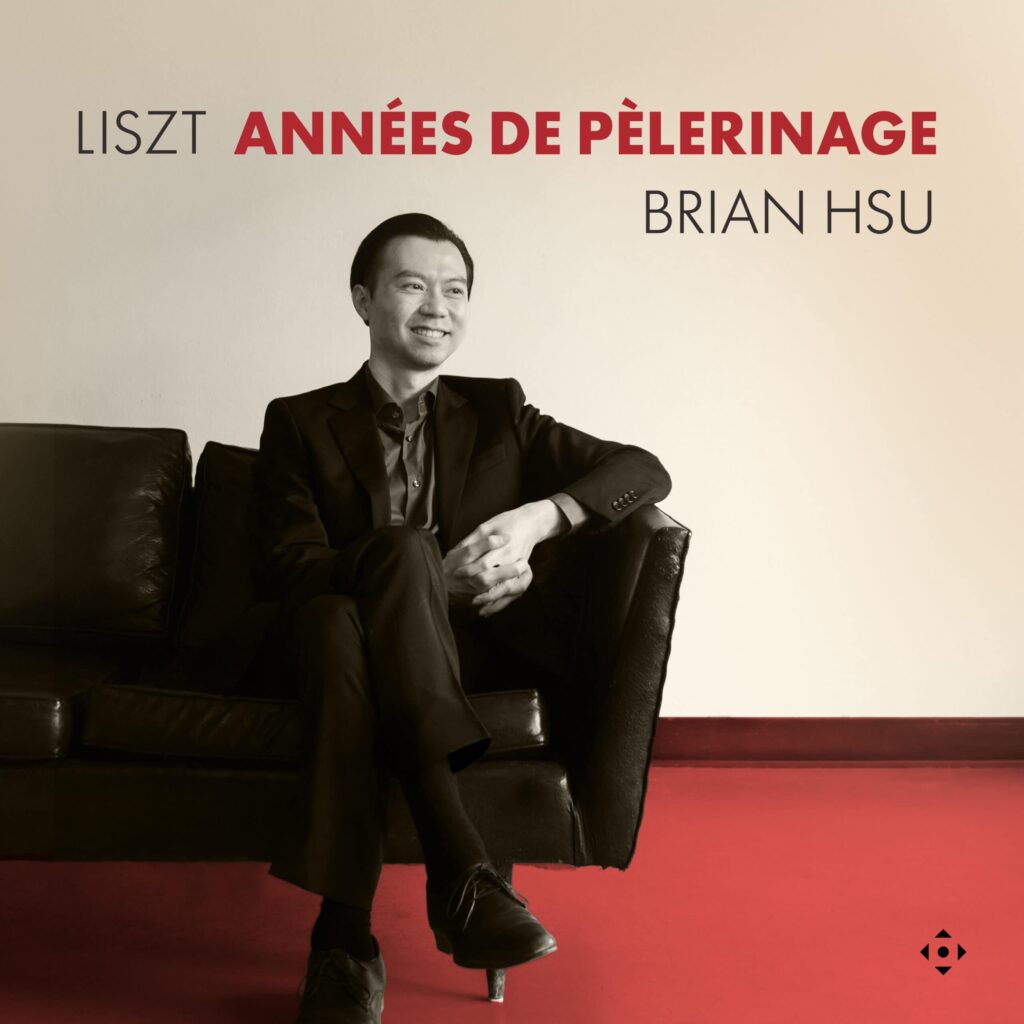
Brian Hsu’s complete Années de pèlerinage stands titanically among the most informed interpretations of the great Liszt cycle, not only for its pianistic quality but also for the philological depth with which the Taiwanese-American soloist approaches a corpus that reveals the evolution of Liszt’s language: from the Romantic tension of his youth to the ascetic rarefaction of his late period. Hsu himself, in the liner notes, states how his relationship with Liszt began early, “attracted by the imagination, virtuosity, emotional range, and expressive power of his music,” and how it allowed him, during the pandemic, to “travel through music.” These words are the interpretative key to the entire project.
In the first volume, Première Année: Suisse, Hsu demonstrates a profound understanding of Liszt’s writing, still imbued with Beethovenian tension and Schubertian lyricism, but already projected toward an orchestral conception of the piano. The Chapel of Guillaume Tell is rendered with a solemnity that doesn’t lapse into monumentality: the full chords, which in many interpretations become blocks of sound, acquire such plasticity that we perceive the harmonic progression, founded on a tonal expansion that prepares the dramatic impetus. In Au lac de Wallenstadt, the arpeggiated figuration in the mid-high register is treated with a controlled pedal, avoiding impressionistic blurring: Hsu emphasizes the function of resonances as a structural, not decorative, element, and the melody emerges with lieder-like cantability. The Pastoral, with its perpetual motion, is interpreted as a tribute to tradition, while Au bord d’une source reveals the performer’s ability to maintain the transparency of the filaments even in rapid figurations: the source is not a scintillating virtuosity, but a place of harmonic regeneration, where modulating progressions give rise to a luminous instability. In Orage, Hsu constructs his storm in waves, with an internal logic that enhances the role of dissonances as points of fracture. The Vallée d’Obermann, the pinnacle of the first book, is approached with rare formal clarity: the pianist captures the implicit tripartite structure, the impact of suspensions, and the friction between question and answer, highlighting the piece’s harmonic modernity, which already prefigures the freedom of late Liszt. Eclogue and Le mal du pays are treated as different ways of looking at nature and memory: with a neoclassical luminosity and a Schubertian melancholy, based on broken lines and modulations that escape tonal stability. Les cloches de Genève closes the book with a nocturne of timbral refinement: the bells are isolated chords that, thanks to the pedal, create a sonorous halo, while the design moves on a harmonic texture alternating between stability and deviations. The supplement Venezia e Napoli integrates into the journey as a bridge between nature and culture. In Gondoliera, the popular melody is treated with a measured rubato, which enhances its narrative value; the Canzone is rendered with a singability reminiscent of the Italian vocal tradition; the Tarantella, though arduous in its writing, is approached with a rhythmic clarity that underscores the logic of repetitions and modulations.
The second book, Deuxième Année: Italie, marks the moment when Liszt converted the Italian aesthetic experience—painting, sculpture, poetry—into pianistic language. In the Sposalizio, Hsu emphasizes the architectural construction: the melody, initially linear, expands through ornamentation and modulation until it takes the form of an ascending gesture. The Penseroso demonstrates his ability to bring out dissonance as an expressive core, treating every tension as a sculpted thought. The Canzonetta del Salvator Rosa is interpreted with a vigilant lightness, preserving its irony without simplifying it. In the three Petrarchan Sonnets, Hsu demonstrates a rare mastery of Liszt’s cantability: No. 47 is meditative, No. 104 ardent, No. 123 introspective. In each, the melodic line is grafted onto a mobile harmonic texture, where shifts and progressions generate a continuous emotional flow. After a lecture on Dante, the book’s fulcrum, is approached with formal rigor: the pianist highlights the cohesion of the Fantasia quasi-Sonata, the function of the thematic blocks, and the dialectic between dramatic and contemplative sections, conveying the complexity of Liszt’s thought with structural clarity.
The third book, Troisième Année, belongs to the late Liszt, who, as Hsu writes, “strips his language to its essence” and, harmonically, “looks forward, paving the way for composers who will follow him.” In Angélus!, the handwriting becomes almost monodic: few lines, few harmonies, much air. The two Threnodys explore new territories: unresolved dissonances, progressions that avoid the traditional cadence, use of the low register as the site of dense tà. Les jeux d’eaux vibrates with liquid light, but Hsu avoids superficial impressionism: the rapid figurations, the play of registers, and the use of the pedal are traced back to Lisztian dialectics. In Sunt lacrymae rerum, the “Hungarian mode” is memory, not folkloric color; the Marche funèbre is Brahmsian dignity; Sursum corda closes with a gesture of elevation that, harmonically, translates into a progressive clarification of the texture. The Années de pèlerinage trace, for Hsu, “a physical and emotional journey” in which the first two books represent “youth, exploration, discovery,” while the third is “a spiritual pilgrimage, an inner journey of reflection and acceptance.” The greatness of this complete work lies in its ability to convey the trilogy as a unitary organism, without sacrificing the specificity of each piece.
The highly advanced piano technique is striking for its discretion. The sound is meticulously crafted, the pedals rigorous, and the dynamic control exemplary. This box set captures the authentic metamorphosis of the Hungarian composer, who, through his journey, searches for himself, his faith, and his time, and, in doing so, pushes his piano language toward the unknown. With critical intelligence and poetic sensitivity, Hsu invites us to embark on this pilgrimage with him, from the Swiss mountains to the Italian waters, all the way to the pensive silence of the Villa d’Este. It is a philologically attentive and harmonically aware work. An interpretation worthy of admiration.