







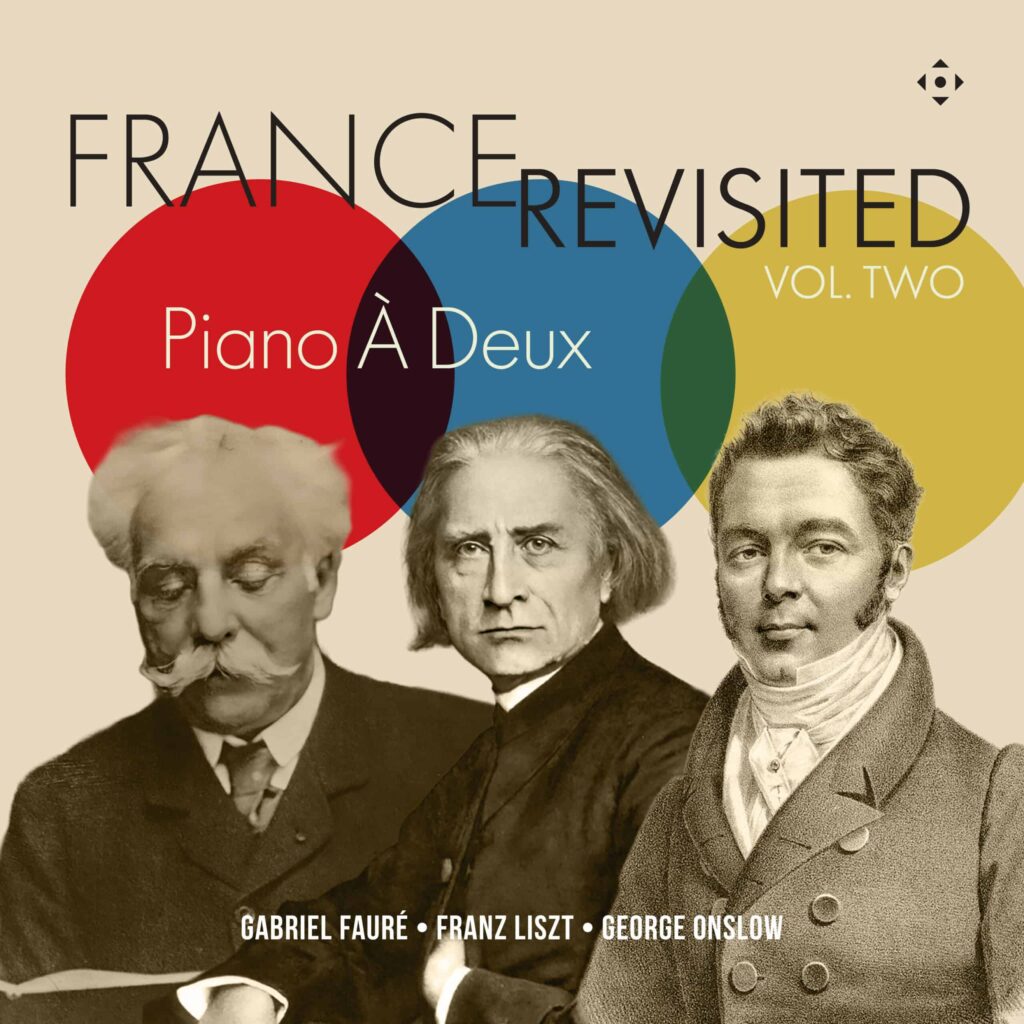
Piano À Deux consists of the husband-and-wife team of pianists Linda Ang and Robert Stoodley. After meeting online, the two married in 2008 and founded Piano À Deux in 2010. Their latest album is titled France Revisited Vol. Two. The first volume was reviewed positively by Daniel Morrison in Fanfare 41:4, and this follow-up is also enjoyable…
Liszt’s Hungarian Rhapsody No. 2 is given in a four-hand arrangement by Franz Bendel, with added cadenzas by the Stoodleys. No explanation is offered in the program notes about what this work has to do with the theme of France revisited. The performance demonstrates a high level of keyboard technique and the kind of excellent ensemble that results when two pianists are clearly listening to each other. There are moments when the Stoodleys could be more playful (there is a reason why this piece has attracted the likes of Victor Borge and Bugs Bunny), but in any event it is fun to hear this virtuoso arrangement, particularly the sparkling cadenza that has been added to the final section.
The music of French composer George Onslow (1784–1853) is far less well known than Fauré’s and Liszt’s. As his name indicates, Onslow was of English descent on his father’s side, and he had independent means as the grandson of the Earl of Onslow. The first of his two sonatas for piano four hands was presented on Piano À Deux’s first volume, and this later 35-minute sonata is the major attraction here. High on the list of historical concerts I would love to have attended is a recital from Paris in 1834, when Liszt and Chopin played this sonata. That should give you an idea of how highly regarded Onslow was in his day, although the French criticized his music for being too German.
Sonata No. 2 was composed in 1823 and is a substantial and imaginative work. Onslow here demonstrates melodic inspiration, harmonic inventiveness, and a deep knowledge of keyboard writing. One can understand why he was called “Beethoven français.” The Stoodleys are at their best here. They bring the right combination of strength and poetry to the score, making a strong case that Onslow deserves far more attention than he is given.
The recorded sound is ideal, and the program notes are informative if brief. Recommended, particularly for the Onslow sonata, which was a real discovery for me.