





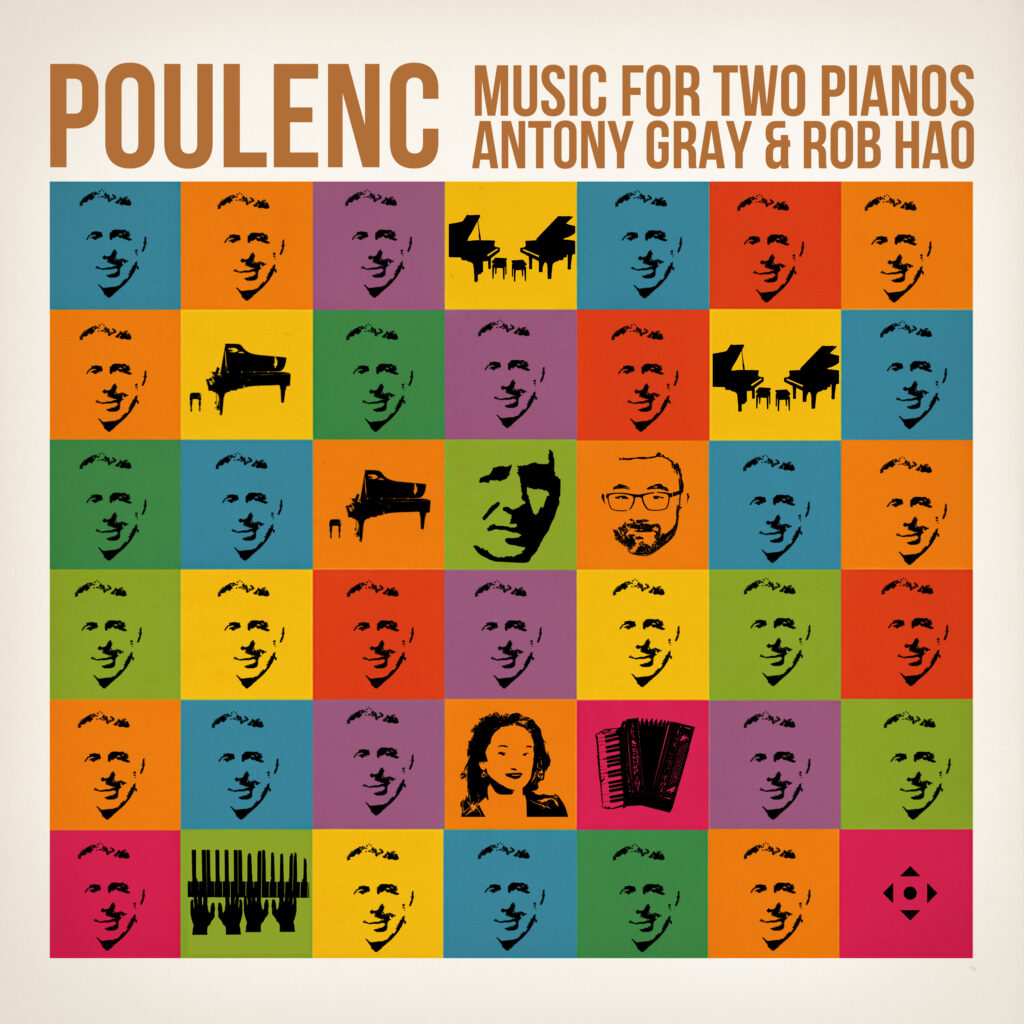
Antony Gray and Rob Hao’s fabulous two-piano album contains possibly my favourite Poulenc piece ever, the sublime Élegie, directed to be played “as if you were improvising it, a cigar in your mouth, a glass of cognac on the piano.” Listen carefully and you’ll notice the syncopated chordal accompaniment moving between the two pianos, both players getting a shot at the tunes. The main draw here is the rarely heard two-piano version of the Concert champêtre. Poulenc liked to perform the solo harpsichord part on piano, and there’s a superb recording of it by pianist Mark Bebbington on the Resonus label. Gray and Hao’s performance strips things back even more. But, ‘as the musical material is so strong, and the reworking so clearly thought out’, who’s complaining? It sounds magnificent and really should be a part of two-piano repertoire. This performance is great: try the quicksilver opening of the finale and marvel at the pair’s coordination, and to how well the judge the concerto’s introspective closing minutes.
The other large work here is the Sonata for Two Pianos from 1953, a big-boned, emotionally rich four-movement piece. Gray’s booklet note includes Poulenc’s own introduction to the sonata; it’s fascinating to read that he thought of the earlier Concerto for Two Pianos “as blithely bravura, whereas the sonata has the gravity of a string quartet”. This is an occasionally sombre work with some exhilarating fast music – Gray and Hao tear into the opening of the second movement, and the “Epilogue” is both exciting and deeply moving. Light relief comes in the form of L’embarquement pour Cythère, a fizzy waltz taken from Poulenc’s score to the 1951 film Le Voyage en Amérique. The manuscript of the entire score hasn’t survived, but we do get 17 short, effervescent cues transcribed directly from the soundtrack. Accordionist Alise Silina joins the pair for a recap of L’embarquement and the physical disc ends with soprano Helen Miles singing the delightful “Adieu Maison”, also extracted from the soundtrack. A fantastic collection wonderfully well played, and, if you go for the digital version, you also get the Sonata for four hands, the Capriccio and the Valse de musique de soie.