








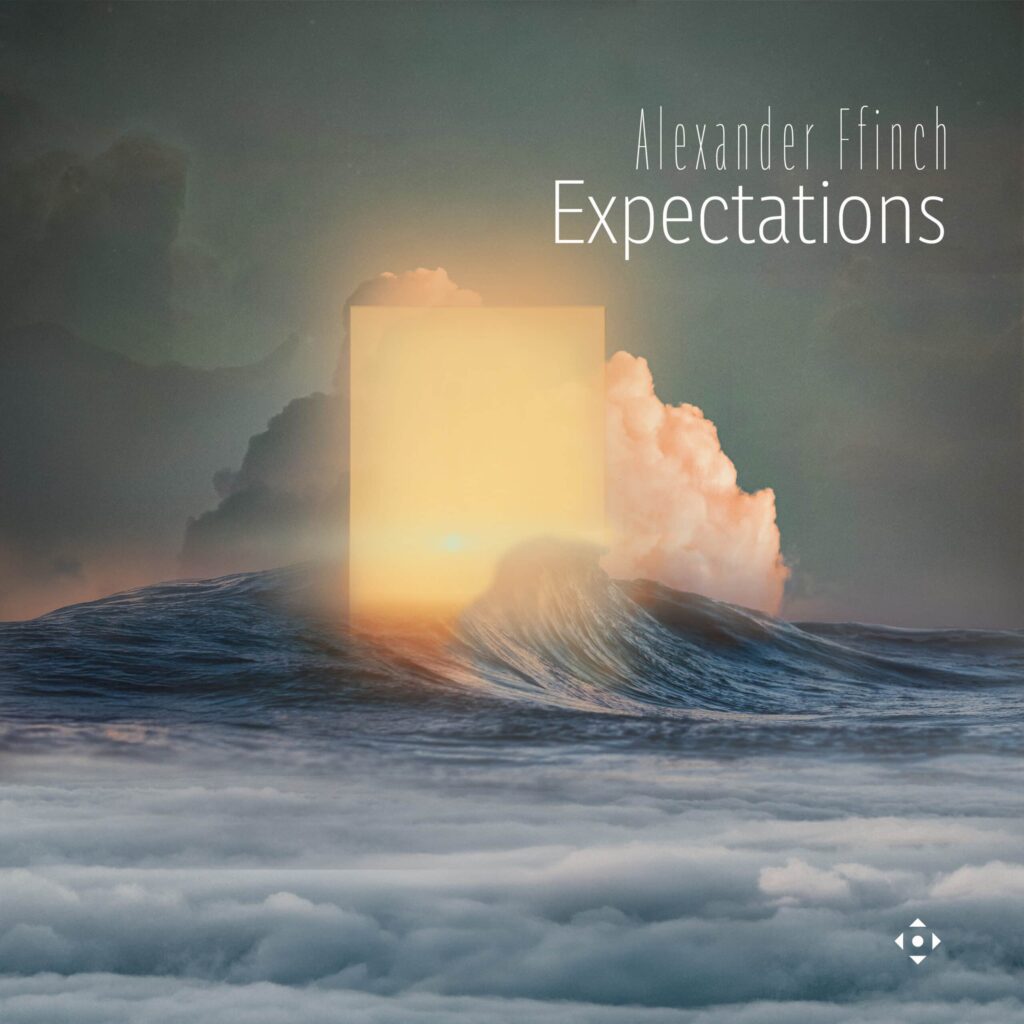
The title of this disc, Expectations, is related to the changing of the seasons and our reactions to them, including our expectations. Thus, Saint-Saëns’s Danse macabre refers to the appearance of Death at Hallowe’en (“with his ‘E string’ tuned to an ‘E flat’”). This is an expert arrangement by Edwin H. Lemare, and Ffinch’s registration makes it a deliciously multicolored affair. It is magnificently played, with a recording to match: Colin Rae’s engineering is exemplary, and this piece is a sonic spectacular in which the wind howls around the gravestones most bracingly.
Written a decade earlier, in 1864, Alexandre Guilmant’s Marche funèbre et Chant séraphique continues the theme of death, now with an inevitable tread. Ffinch captures the solemnity of the first part as effectively as he does Guilmant’s vision of Heaven in the seraphic song. It is notable how effectively the growth of dynamics is achieved, how tight Ffinch’s rhythmic grasp is in the funeral march, and how striking the contrast becomes as the music swirls upward against a melody of reassurance and peace. Guilmant’s melodic invention is noteworthy: this is a most effective depiction of a journey to the Elysian Fields.
The name of Derek Bourgeois is known to many brass band players for music of great expertise and often jaunty demeanor. Both qualities are present in his organ Serenade, Op. 22 (1965). It sits comfortably alongside some of the happiest music in the repertoire and should be issued as a healthcare aid without prescription. When the pedals take up the melody, the antics in the manuals are delightful. Yes, there is a hint of the fairground organ, but that is no bad thing. And most fairgrounds would not countenance Bourgeois’s metric play—or even some of his cheeky dissonances.
The booklet is brilliantly detailed. Ffinch writes generally about the concept and most of the music in the first section; the third (more on the second anon) is a question-and-answer interview with composer William Mason (born 1981) about his treatment of the Lutheran Advent hymn Nun komm der Heiden Heiland (Saviour of the Nations, Come), itself derived from the plainchant Veni Redemptor Gentium (Come, Redeemer of the Nations). What stands out in Mason’s arrangement is his respect for the original: he surrounds it with music that strongly suggests mysticism. It certainly stands in high contrast to a string of three excerpts from Tchaikovsky’s Nutcracker. Two are arranged by Reginald Goss-Custard—a light-on-its-feet Overture Miniature and a witty Danse des Mirlitons—which sandwich Ffinch’s own realization of the Danse russe, a tightrope act between detail and speed expertly negotiated by the arranger in performance.
It is lovely to have Holst represented here. The Brook Green Suite seems to have waned somewhat in popularity of late, so it is good to hear the charming Air from this 1933 work. Holst’s characteristic harmonies give the piece a distinctive individuality.
We are a long way from Christmas (I’m writing this in June), but some might say it is never too early, so here is Marcel Dupré’s Variations sur un Noël, Op. 20. This is certainly not music to accompany a mince pie or two; rather, it is a highly sophisticated set of variations, each one clearly delineated by Ffinch. There is even a hint of Danse macabre in the fourth variation (Vif), but it is the finger-twisting fifth (Vivace) that impresses on multiple levels, not least technically. Sometimes known as Variations sur un vieux Noël, this is a major work—and Ffinch faces formidable competition in the catalog, not least from Gillian Weir—but his performance carries the listener along as though no other interpretation existed. The organ sounds magnificent throughout, culminating in a ground-shaking pedal statement of the theme in the closing fugato (Variation X).
Fanny Mendelssohn’s Das Jahr is a cycle of 12 pieces plus an epilogue, somewhat along the lines of Tchaikovsky’s The Seasons. Ffinch offers his own arrangement for organ of the Epilogue, a Bachian chorale that works beautifully. It may seem an unlikely companion to David Bowie’s Life on Mars?, but why not? The arrangement was originally commissioned as exit music for a wedding (the subject of the second of the booklet’s four chapters); this new version, created a decade later, is stunning in both craftsmanship and beauty.
Finally, there are two pieces by Marcel Lanquetuit, a pupil and later colleague of Marcel Dupré. The Intermezzo (1923) is gentle and formally concise, nestling alongside the Toccata (1927), which shares certain traits with the Dupré Variationsheard earlier on the disc. It is also magnificent, demanding extraordinary virtuosity to make its full effect. Ffinch delivers that and more. It is the perfect conclusion to an ideally balanced and stimulating program. And don’t dismiss the Bowie arrangement until you’ve heard it!