







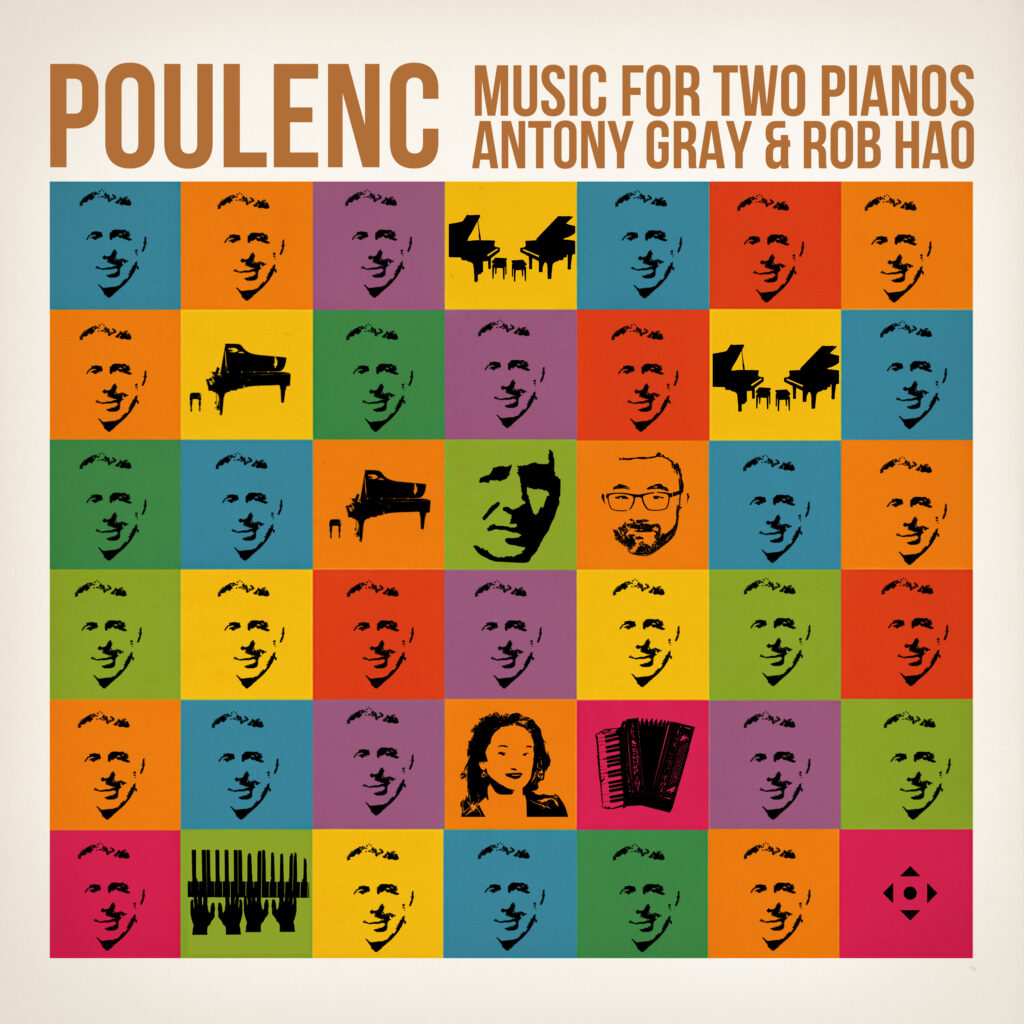
The recital opens with one of my favourite pieces by Francis Poulenc: L’Embarquement pour Cythère. It is the only published number linked to his score for the film Le Voyage en Amérique, though its exact origin remains a bit of a mystery. It was originally requested by the American piano duo Robert Fizdale and Arthur Gold, affectionately called “Les Boys”, for a 1952 concert in New York. Poulenc described it as “an evocation of the banks of the Marne, so dear to my childhood”, and impudently suggested to the duo: “I don’t think you should include it in your programme, but rather keep it as a bombe-surprise for an encore”.
In Greek mythology, Cythera is an island associated with the birth and cult of Aphrodite, the goddess of love. Ancient sources describe her rising from sea‑foam near the island before travelling on to Cyprus. In art and literature, “going to Cythera” becomes a poetic metaphor for journeys toward love, beauty and sensual longing. That is exactly the symbolism Poulenc draws on in this work.
The Concert champêtre was first developed as a concerto for harpsichord and orchestra. Poulens composed it for the legendary harpsichordist Wanda Landowska, whose pioneering performances and teaching played a significant role in the 20th-century revival of the instrument. As the liner notes explain, Poulenc later expanded the solo part for the piano, a version he frequently performed himself. He also arranged a reduction of the orchestral score, effectively creating an authorised version for two pianos.
Interestingly, Karl B Schmidt in his indispensable catalogue recalls Poulenc’s comments: “the piano version of the Concert champêtre is only a poor substitute, you hear me right, a poor substitute”. Yet, fittingly, Landowska gave the work its private premiere, and Poulenc accompanied her on a second piano.
The concerto unfolds in three distinct movements. The opening is introduced by slow, solemn, slightly discordant measures; they quickly give way to an Allegro molto in a bright, 18th-century style full of the cheerful irreverence typical of Poulenc at that time. The central Andante is a tender, melodically and harmonically exquisite inspiration. The Presto finale (très gai) masterfully sets Handelian brilliance against Stravinskian bite, all held firmly by Poulenc’s neo-classically disciplined control.
Élégie for two pianos is one of the most heart-breaking numbers that Poulenc composed. He wrote it to commemorate the death of his friend Marie-Blanche de Polignac, the French aristocrat, soprano, pianist and patron of the arts. The piece begins wistfully before building up into a considerable climax with increasingly bittersweet chords. The subtitle of Élégie is “en accords alternés”; this is represented by chords passed back and forth between the players until they come together for the tormented coda. The work gets a suitably tragic performance here. Amusingly, Poulenc left a note in the score instructing the pianists to perform it with a relaxed, spontaneous feel: “as if you were improvising it, a cigar in your mouth, a glass of cognac on the piano”.
The ambitious Sonata for two pianos takes a little bit of effort to fully unearth. This is not Poulenc’s lighter, satirical style. Instead, it demands engagement with weighty and often emotionally charged music. W have drama, darker episodes, chorale-like textures, and not a few “soaring” melodies thrown in for good measure. Aggressive dissonances are sharply contrasted with passages of achingly beautiful material. Poulenc wrote the piece for the above mentioned “Les Boys,” who premiered it in a BBC broadcast in London on November 2, 1953. Poulenc later noted that he began the score in a room at the Hôtel Beauvau in Marseille in December 1952, the hotel where Chopin stayed at with George Sand upon returning from Majorca.
Structurally, the sonata is built around its emotional core, the third-movement lyrical Andante lyrico. The Prologue introduces contrasting, stormy themes, while the Allegro molto offers a dynamic scherzo with a cool centre. After the Andante have given the work its reflective heart, the Epilogue revisits earlier material, framing the entire sonata with a haunting final thought.
One of the reasons I looked forward to reviewing this disc was Le Voyage en Amerique. I knew about the score but have never had the opportunity to hear it. Poulenc devised the music for the 1951 eponymous film. According to Wikipedia, the plot deals with a French couple travelling to America for the childbirth of their daughter who had married a GI. They confront culture shock and rediscover their quiet life’s value back in La Belle France.
Much of the music is in a popular dance hall style, with lots of swing, panache and vivacity. On the other hand, a touch of the “melancholic” acts as a kind of sympathetic undercurrent. The performance as presented here is made up of noticeably short cues, sometimes only a handful of bars long. Is that a “pistol” shot in the fourth section, a piano lid falling shut or a box of bolts falling on the floor? The final part of the “suite” reprises L’Embarquement pour Cythère,now with the addition of an accordion. Very Gallic.
What makes this release truly remarkable, however, is that – as the liner notes sayn – the original holograph (manuscript) was lost. The present transcription had to be produced “by ear” entirely from the film’s audio soundtrack. This kind of ability always impresses me; a touch of genius is required to make such a realisation. Poulenc gave Yvonne Printemps, an old friend and collaborator, two songs for the film: Chanson de marin and Adieu maison. Only the latter has been included on this disc, because the former had been previously recorded. This is a pity.
The release is an essential addition to any French music enthusiast’s library. Antony Gray and Rob Hao navigate Poulenc’s distinct sound world with complete assurance. They balance his trademark music-hall irreverence against the profound, darker undercurrents of the Sonata and Élégie. Alise Siliņa’s brief accordion contribution adds a wonderful touch of Parisian nostalgia; Helen Miles delivers a poignant Adieu maison. Even if Poulenc grumbled about the two-piano Concert champêtre, it sounds marvellous here. Combined with the remarkable “ear-transcription” of the lost Le Voyage en Amérique score, this beautifully recorded disc offers a deeply rewarding, thoroughly authoritative recital.